


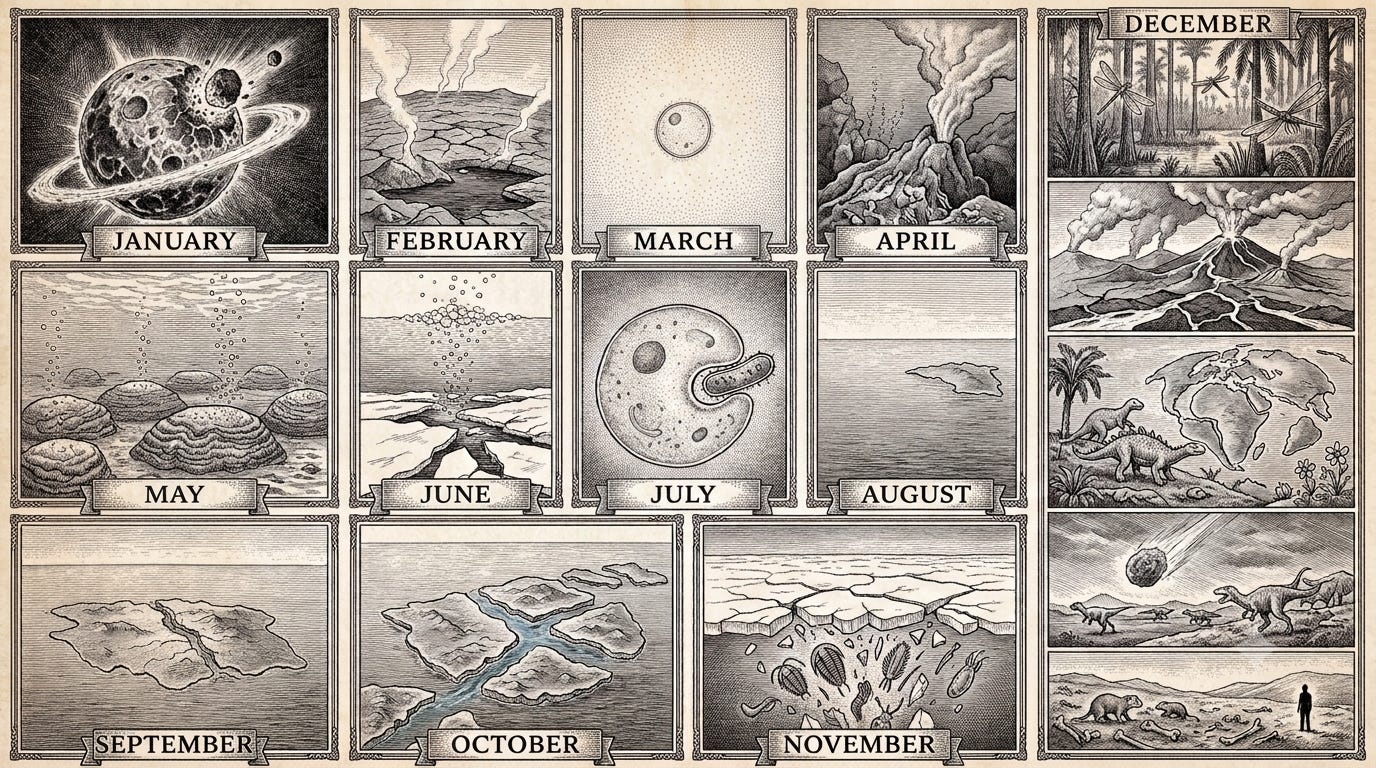
We spend a lot of time on this Substack talking about exponentials, in chips, energy, AI, and space: the steep parts of the curve where progress feels almost magical. But every exponential rests on a long, boring, invisible foundation. This one is about the foundation our own planet spent billions of years quietly laying down.
Imagine squeezing all 4.6 billion years of Earth's history into a single year. Today is December 31st. Midnight is right now.
This device itself is not new. Carl Sagan popularised it in his 1977 book The Dragons of Eden, and again three years later on Cosmos, compressing the entire history of the universe, roughly 13.8 billion years, into the same twelve months. In his calendar, the Solar System and Earth do not appear until early September, and everything humans have ever done fits into the last ten or so seconds before midnight. This is that same device, run again but zoomed in: start the clock at Earth's formation instead of the universe's, and a single day buys three times the resolution, room enough to spend the whole year on nothing but this one planet.
At this scale, one day equals about 12.6 million real years, and a single hour is worth over half a million. Worth saying upfront: most of the dates below are reconstructions, pulled from mineral grains, ice cores and fossil beds, and they carry error bars that a calendar conveniently hides.
One calendar day equals 12.6 million years. A single hour, over half a million.
January: A New Planet
Earth forms out of swirling dust and rock on January 1st. Just a week later, on January 8th, a Mars-sized object slams into the young planet; the debris left behind, spun into orbit, becomes the Moon. For the rest of the month, Earth is a molten, crater-battered ball, closer to a small star than a place, its surface too hot for anything solid to hold its shape. Not yet anywhere you'd recognise.
February: The Fire Cools
By around February 17th, the surface has cooled enough to form solid crust. Surprisingly soon after that, there are hints, locked inside tiny zircon crystals, the only physical evidence that survives from this far back, that liquid water, maybe even oceans, already exist. The hellscape part of Earth's story turns out to be short. Everything after this is a long, long wait.
March: Life Begins
Sometime around March 12th, something happens that we still don't fully understand: non-living chemistry turns into a living thing. This is the biggest mystery on the whole calendar, more consequential than anything that follows it, because there's no direct proof of how it happened. Only inference.
Every living thing today traces back to one common ancestor, a single ancient cell researchers nickname LUCA (Last Universal Common Ancestor), dated to somewhere between 4.2 and 3.5 billion real years ago. But LUCA already has ribosomes, DNA replication, ATP synthase: real cellular machinery. Which tells us a great deal of invisible evolution happened before LUCA, in a stretch of calendar-time we have essentially no record of at all.
This one transition, arguably the most consequential of the year, happens entirely in the dark.
Everything before this date is geology and chemistry, reconstructable from rock. Everything after it is biology, and eventually palaeontology, with an actual fossil record, and every animal, every extinction, every fragment of this story traces back to this one starting point.
April to June: Learning to Use Sunlight
The next big trick: some bacteria learn to pull energy from sunlight. This earliest form of photosynthesis strips electrons from hydrogen sulfide, but that's a scarce ingredient, so this kind of life stays confined to a few scattered spots, like volcanic vents.
Then cyanobacteria work out how to do the same trick using water instead: chemically stubborn to split, so they evolve a manganese-calcium cluster and wire two light-capturing systems together in sequence to gather enough energy to tear a water molecule apart. Water is everywhere, so this lets life spread across the entire sunlit ocean for the first time. Oxygen is simply the exhaust from that reaction.
For a long stretch, none of it builds up in the air; it's soaked up instantly by iron dissolved in the ocean, like a sponge. By around June 24th, the sponge is full. Oxygen finally starts building up in the atmosphere for the first time in Earth's history: the Great Oxidation Event, and by most reasonable definitions the calendar's first mass extinction, since oxygen is a poison to nearly everything alive at the time.
It very nearly ends the story early, too. Oxygen reacts with atmospheric methane, a potent greenhouse gas, and strips it from the sky. Without this greenhouse gas, temperatures collapse and the planet freezes over almost pole to pole: the Huronian glaciation, the first Snowball Earth, lasting what would be several calendar-weeks here.
July to October: The Quiet Stretch
Around early August, a new, more complex kind of cell appears: the kind that makes up your body, and every plant and animal alive today. The birth of the eukaryote. This is marked by the moment one simple, oxygen-using bacterium got swallowed by a larger cell and, instead of being digested, stuck around as a permanent partner, gradually specialising into the cell's energy producer. That partnership became what is called mitochondria, the tiny power plants still living inside every cell in your body. A merger so old and so total that nothing since has needed to question it, or change it.
Then, for months, almost nothing visibly happens. Geologists call this stretch the Boring Billion. A supercontinent called Rodinia slowly assembles and drifts apart. That's the news, for three straight months.
November: Ice, Then an Explosion
Early in the month, the planet freezes over again, and worse. Two Snowball Earth episodes, the Sturtian and the Marinoan, ice the globe almost completely, glaciers reaching close to the equator, across a combined stretch running roughly November 4th to the 12th. These are some of the calendar's most dramatic days.
The planet nearly freezes solid, twice, in the days just before the Cambrian Explosion. Nothing about a global ice age looks like the run-up to an explosion of life.
Then, on approximately November 18th and 19th, over about a day and a half of calendar time, something like 20 million real years, nearly every basic animal body plan alive today, and plenty that aren't any more, appears almost all at once. Shells. Jointed legs. Eyes. This is the Cambrian Explosion, and it's the one big transition on this entire calendar that isn't caused by a disaster clearing space for something else; it's life simply standing up on its own, for the first time.
Late November: The First Big Die-Off
A few days later, the Ordovician-Silurian extinction, a glaciation and sea-level whiplash, wipes out roughly 85% of species in the ocean. Not long after, in the recovery, plants and then small arthropods crawl onto dry land for the first time. A second, quieter extinction follows soon after, in the late Devonian, likely tied to oceans starved of oxygen.
Early December: Coal Forests
In the first week of December, giant swampy forests spread across the world. The fungi that would normally rot dead wood haven't evolved that ability yet, so fallen trees pile up instead of decomposing. Atmospheric oxygen spikes to around 35%, a third higher than today, and dragonfly relatives grow wingspans the size of seagulls on the surplus. All that unrotted wood, over time, becomes coal: the same coal still being mined and burned today, a hundred million years of trees the planet never got around to composting. Every scoop shovelled into a furnace is undigested Carboniferous timber, arriving a hundred million years late.
December 11th: The Worst Day
This is the single worst day on the entire calendar. Sustained volcanic eruptions in what is now Siberia - a prolonged outpouring of lava and gas lasting thousands of years rather than a single blast - acidify the oceans, drive up carbon dioxide levels, and starve the seas of oxygen. Roughly 90% of all species on Earth die. It is called, with blunt accuracy, the Great Dying: every other mass extinction on this calendar is a bad week, but this is the year’s only true catastrophe.
Mid-to-Late December: Dinosaurs, Then a Rock From Space
Life recovers. A new lineage, the archosaurs, takes over as the dominant animals on land; dinosaurs come to dominate as the supercontinent Pangaea splits apart into the continents we'd recognise today. Tyrannosaurs, sauropods, and the rest of the menagerie familiar from museum halls all belong to this stretch. Flowers bloom for the first time.
Then, on December 26th, a ten-kilometre asteroid strikes what's now Mexico. Non-avian dinosaurs, along with roughly three-quarters of all species on Earth, are wiped out in what would be, on this calendar, a single afternoon.
The Last Few Days: Mammals, Then Us
With dinosaurs gone, mammals, sidelined for nearly the entire month of December, finally get their opening, radiating rapidly into the empty niches left behind: the lineage that eventually produces whales, bats, and the primates that become us.
Homo sapiens appears at approximately 11:26 PM tonight. Strike a match and let it burn down towards your fingers: by the time it goes out, you've watched roughly as long as it takes for the entire span of recorded human history to pass on this calendar. Farming, cities, empires, the device you're reading this on: all of it, in the time it takes a flame to travel down a matchstick.
What This Actually Teaches Us
We only call certain moments important because of what they led to. Nobody living through eight months of bacteria slowly refining a handful of enzymes would have known anything significant was happening. It only reads that way now, because we already know where it led.
Importance is something you can only assign in hindsight. You can't see it from inside the moment.
It's entirely possible the real work happened during exactly the stretches this calendar skips past in a sentence: the slow optimisation that built the cellular toolkit every later, flashier event would depend on. That groundwork never resolved into a recognisable before-and-after while it was under way, and so it never got a name.
We're living in the burn of a single match, mistaking the speed of the flame for the speed of the whole matchstick.