


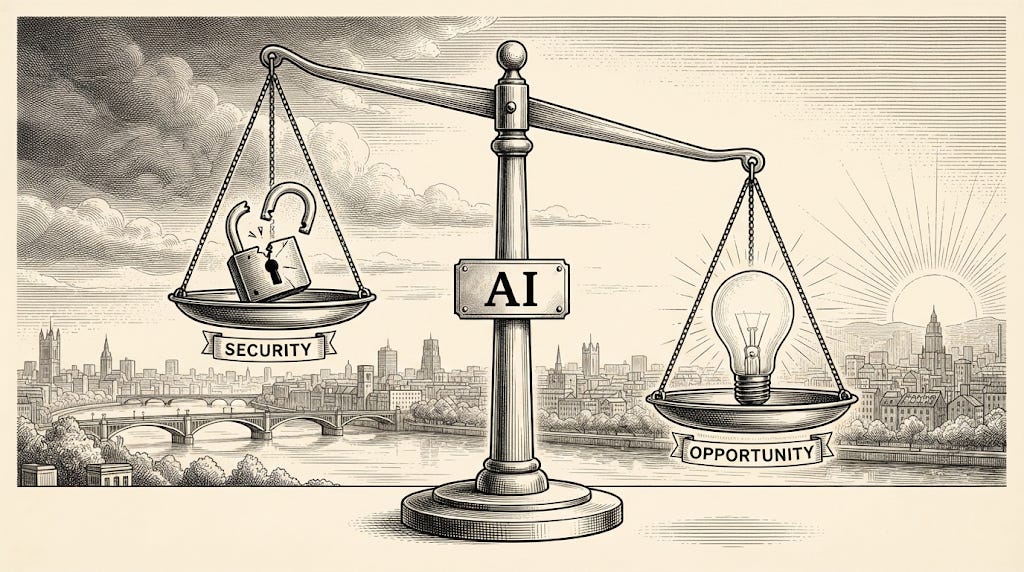
A Backdoor Caught by Half a Second
In March 2024, Andres Freund, a software engineer at Microsoft, noticed something small. He was running performance tests and wanted his machine quiet, but its login service was working far harder than it should, even on login attempts that failed at once. When he timed one, it took about half a second longer than it should: 0.8 seconds instead of 0.3 [1].
Freund went looking for the cause. He traced it to xz, a small, free tool for compressing files that ships with most versions of Linux, the free operating system behind most of the internet’s servers. Someone had hidden a backdoor inside it: a secret way in that, under the right conditions, would have let its owner take control of any affected server. The harmful code had been tucked into files that nobody normally reads [2].
xz is open-source software. Anyone can read its code and offer improvements, and every message and change is kept in public. That openness let the attacker in. It also left a trail, so researchers could later piece together what had happened [3].
For years, xz had been looked after by one man, Lasse Collin, unpaid and in his spare time. In October 2021 a newcomer using the name Jia Tan began sending in small improvements. In 2022 two other accounts appeared on the project’s public mailing list, complaining that work was too slow and pressing Collin to hand some of the control to someone else. Collin replied that xz was an unpaid hobby project and that his capacity to work on it was limited [4]. The obvious person to step in was the helpful newcomer. From March 2023 Jia Tan was publishing the official versions of xz, and in early 2024 two new versions carried the backdoor [3]. The complaining accounts are widely suspected to have been run by the same attacker, although that has never been proven.
What held the attack back for more than two years was the cost of earning Collin’s trust, one patient contribution at a time. Very little of that cost was technical, and the attacker was willing to pay it.
A separate episode, ten years earlier, shows the other side: what the defenders could afford to pay.
OpenSSL is a different piece of free software, unrelated to xz. It scrambles much of the internet’s traffic so that outsiders cannot read it, and it is part of what puts the padlock in your browser’s address bar. In 2014 researchers found a flaw in it, nicknamed Heartbleed, that could leak passwords and other private data from roughly a sixth of the world’s secure websites. The flaw had been sitting in the code, in plain view, for more than two years [5].
How could something so important go unnoticed for so long? Because almost nobody was being paid to look. Software that protected a large part of the internet was looked after by a handful of volunteers, only one of whom worked on it without another job, and the foundation set up to support the project received only about two thousand dollars a year in donations [6].
That is the imbalance. In the xz case, the attacker could afford years of patience. In the OpenSSL case, the people defending some of the internet’s most important code could barely afford attention.
Difficulty Was a Lock and a Tax
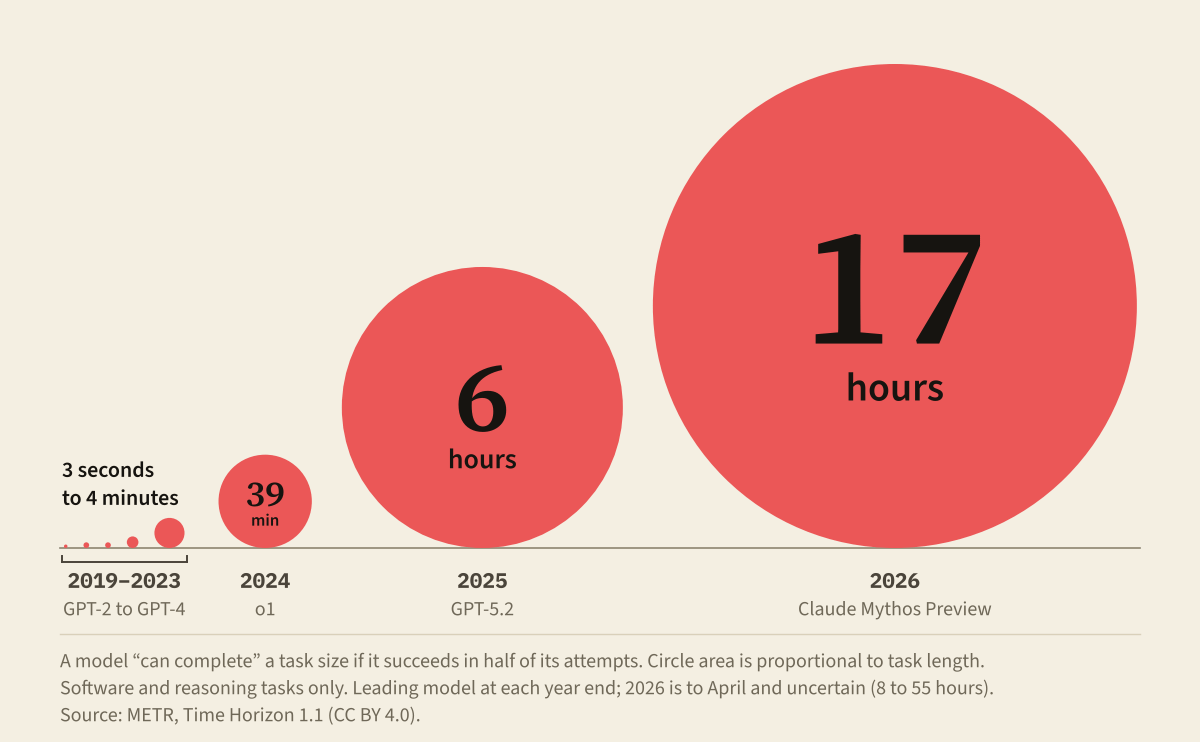
A great deal of the world’s security works the same way: it rests on things being hard to do. Forging a convincing letter once required a craftsman. Writing code that could break into a system took rare skill and weeks of work. Finding a subtle software flaw could take a skilled researcher days. Because these things were hard, few people did them, which kept the numbers manageable for the people on the other side.
In each case difficulty did two jobs at once. For someone who meant harm, it was a lock: most could not afford the effort to get in. For everyone else, it was a tax: the same effort had to be paid by anyone who wanted to do something useful. Nobody designed this lock. It was a side effect of things being hard, so nothing stands ready to replace it when they stop being hard.
It was never a fair lock either. It stopped casual attackers but not the determined ones, who could afford two years of patience. And, as Heartbleed showed, the same difficulty weighed hardest on the people defending the code.
AI removes difficulty, so it lifts the lock and the tax together. The security panic is the first place we have felt the lock come off. The CVE list, the public register of known software flaws, added about 48,000 entries in 2025 [7]. This year it passed 100,000 in mid-November, by the count of VulnCheck, one of the firms that tracks the list [8]. VulnCheck’s Josh Bressers puts most of this year’s jump down to AI-driven bug hunting [8]. Attackers have the same tools. In November 2025 Anthropic reported that a group it judged to be state-sponsored had used its models in an espionage campaign against about thirty organisations, and estimated that the AI had carried out 80 to 90 per cent of the work [9].
Security Is Now a Race Between Attacking and Fixing
AI has made looking for flaws cheap, and that changes the contest. While finding flaws was expensive, the advantage lay with whoever could pay for the search, and patient attackers could. When finding is cheap for everyone, security becomes a race between two clocks. One measures how long an attacker takes to turn a newly found flaw into a working attack. The other measures how long a fix takes to be written and then installed on every machine that runs the code. The second clock is usually the slower one, because people still have to check each fix and install it.
One programme shows the slow clock in numbers. As part of its Project Glasswing, Anthropic uses its models to scan open-source software for flaws. By 2 November 2026 that scanning had produced 37,966 possible flaws. Outside security firms had independently reviewed 6,376 of them and confirmed 94 per cent as real. A total of 5,087 had been reported to the maintainers of open-source projects, some after that review and some directly, and 629 of those had been fixed, about one in eight [10]. The figures come from different stages of a programme still under way, so they do not form a single pipeline. They do show where the work now is. Finding flaws is the cheap part. Checking them, reporting them and, slowest of all, getting someone to make the fix are the expensive parts. That work falls on the people this story began with: maintainers like Collin, many of them unpaid, with a limited number of hours.
When Answers Are Cheap, Checking Is the Hard Part
So the hard part has moved. Finding a flaw used to be the expensive step. Now machines find them by the thousands, and the expensive step is checking: is each flaw real, and does each fix work? This goes beyond security. A reported flaw is one kind of answer, and every answer has to be checked before anyone can rely on it. When answers become cheap to produce, more arrive than people can check by hand. The question is whether checking has to stay slow.
Mathematics has just shown that it need not. On 20 November 2026 Levent Alpöge, a mathematician at Anthropic, announced a proof, found with Claude, of the Riemann hypothesis, a 167-year-old conjecture about how the prime numbers are spread out and the most famous open problem in mathematics, along with its broader form, the Generalised Riemann Hypothesis [11]. By the timeline in his note, the key steps came within about six weeks. As released, the proof was far too long for any person to read. It was written in Lean, a language in which a computer can check every step, and ran to some 17 million lines. Yet within about a day the proof of the Riemann hypothesis itself had been certified correct, because a machine did the checking. Independent tools confirmed that the statement proved is exactly the Riemann hypothesis as mathematicians had already written it down in Lean, and several independent checkers accepted the proof [12].
A proof can now be produced in weeks and checked in about a day, by a check that does not care how the proof was made and that anyone can run again. Understanding it is a separate matter, and a slower one. Mathematicians have only begun to work out why the hypothesis is true and what the argument teaches. Terence Tao, one of the most celebrated mathematicians alive, calls this stage digestion: the work of understanding what a result means and whether it matters [13].
A mathematician who found a proof by hand understood it, and the colleagues who checked it had to follow every step. Finding, checking and understanding went together. Here they came apart, each at its own speed:
Generation: producing the answer. About six weeks.
Verification: checking it against a fixed standard. About a day.
Judgement: deciding what it means and whether it matters. Barely begun.
AI has made the first far cheaper and is beginning to help with the second. The third is the hardest to hand over. A check can say whether a standard has been met. It cannot say what the standard should be, or whether the result matters. For now that still falls mostly to people.
When answers are cheap, the scarce thing is knowing which ones are right.
The Opportunity Is Larger Than the Fear
Cheap answers are the source of the fear. They are also the source of the opportunity. The fear is the easy part to see. A broken lock makes the news the same day. The opportunity is harder to see, because it is made of things that have never been done.
I suspect the tax has cost society more than the lock ever saved it. The lock held back only the few who meant harm. The tax was charged to everyone else, on every useful thing they tried to achieve. The damage from lifting the lock is real. But so is everything that was never done because the tax was in place.
This essay has already shown what the tax cost. The flaw in OpenSSL sat in plain view for more than two years because almost nobody was paid to read the code. The Riemann hypothesis stayed open for 167 years, although generations of mathematicians tried to prove it. Neither job got done. Each needed more skilled effort than anyone had to give.
Both are now being done. Machines are reading that kind of code: the scanning described earlier has found about 6,000 flaws that outside reviewers confirmed as real [10]. And a proof that had been out of reach for 167 years arrived in about six weeks. The proof is the stronger evidence. It was the most famous open problem in mathematics, and for a century and a half no amount of human effort had been enough. If the tax can be lifted there, it can be lifted on the many problems that are easier and that nobody has had time for.
So I think the fear has the proportions wrong. The larger prize is all the useful work that used to cost too much to attempt. One proof and one programme of scanning cannot measure that prize. They do show that it is real, and that it can be reached as fast as its answers can be checked. That is the part worth getting excited about.
The lock held back the few who meant harm. The tax held back everyone else.
How This Ends Depends on the Checks We Build
AI speeds up the harmful and the useful alike. Whether the result is good depends on one thing: how cheaply a right answer can be told from a wrong one.
Chemistry has a name for something that speeds things up without taking sides: a catalyst. Many useful chemical reactions would happen on their own, given enough time. What holds them back is a hill the molecules must climb first, and a catalyst lowers that hill. One step in making the building blocks of DNA and RNA would, left to itself, take an estimated 78 million years to run half its course [14]. With its enzyme, which is its catalyst, the same half takes about 18 thousandths of a second [15].
A catalyst lowers the hill in both directions at once, and it never changes where a reaction ends up. It changes only how fast. AI does the same to effort. It speeds up the attacker and the defender alike, which is why the fear is real, and by itself it does not decide where anything ends up.
The cost of checking decides that. Where checking is cheap, being right beats sounding right, and we get true theorems and patched software. Where checking is expensive, a flood of cheap answers rewards whoever sounds most plausible, and we get noise.
The examples in this essay show the range. A machine can check a proof, so the Riemann proof was certified within about a day. Medicine has no proof checker. It has trials. To learn whether an AI system could safely share the reading of breast-cancer scans, a trial in Sweden assigned more than 100,000 women at random to screening with it or without it. The AI-supported screening found 29 per cent more cancers with no significant rise in false alarms, and cut the radiologists’ reading work by 44 per cent [16]. That answer took several years to get. The flaws that machines now find in open-source software wait on maintainers, many of them unpaid, with few hours to spare.
Checks can be built. My own industry shows what that takes. In chip manufacturing, roughly one dollar in every seven spent on chip-making equipment buys machines that make nothing and only measure and inspect [17]. The industry pays that because it has no other way to know whether its steps have worked. Even then a measurement only reports. An engineer still decides what to do about it.
Joscha Bach, a cognitive scientist, calls AI “the technology of existential hope” [18]. In the terms of this essay, his bet is that a civilisation facing global warming, resource depletion, fraying social cohesion and war has far more to gain from lowering every hill than to fear from lowering some. I think he is right, on one condition: we have to build the checks. That means measurements, trials, proof checkers and paid hours for maintainers. Each one we build makes another kind of cheap answer safe to rely on. That is where the work is. The great reduction of friction is still ahead of us.
Looking Is Now Cheap. Checking and Deciding Are Not.
The world has always been full of things worth investigating and not worth the time. Every organisation has its own half-seconds: the batch job that runs overnight because it always has, the step in a procedure that nobody can explain and nobody dares remove. Chasing one to its source used to take luck, and a rare person with time to spare. Most have never been chased. The chasing has just become cheap. Knowing which findings are real, and deciding what to do about them, has not.
Freund was in the middle of other work when a failed login took half a second longer than it should. He went to find out why.
References
Andres Freund, “backdoor in upstream xz/liblzma leading to ssh server compromise”, oss-security mailing list, 29 March 2024. Source of the 0.299 s and 0.807 s timings for a rejected login attempt. Freund’s own account of what he first noticed, a login service using too much processor time while he was benchmarking: LWN comment, 29 March 2024. Freund’s role at Microsoft: The Register, 1 April 2024. openwall.com
Daroc Alden, “How the XZ backdoor works”, LWN, 2 April 2024. The payload hidden in binary test files and release tarballs. lwn.net
Russ Cox, “Timeline of the xz open source attack”. Jia Tan’s first patch (October 2021), commit access, releases and the pressure emails of 2022. Posted 1 April 2024, updated 3 April 2024. research.swtch.com
Lasse Collin, message to the xz-devel list, 8 June 2022, describing xz as an unpaid hobby project with limited capacity. mail-archive.com
“The Heartbleed Bug” (CVE-2014-0160). heartbleed.com Share of secure sites affected, about 17 per cent or half a million: Netcraft, 7 April 2014. netcraft.com
Steve Marquess, “Of Money, Responsibility, and Pride”, 12 April 2014. OpenSSL’s roughly US$2,000 a year in donations. veridicalsystems.com
CVE.icu, yearly counts of published CVE records. Counts differ slightly by source and date: 18,322 for 2020 and 48,150 for 2025 here; 48,185 for 2025 in Jerry Gamblin’s annual review. cve.icu, figures as read on 26 November 2026.
Jessica Lyons, “This year’s bug count just passed 100K”, The Register, 13 November 2026: VulnCheck’s count passing 100,000 CVEs for the year, and Josh Bressers of VulnCheck attributing most of the rise to AI. theregister.com
Anthropic, “Disrupting the first reported AI-orchestrated cyber espionage campaign”, 13 November 2025. About thirty targets; AI estimated to have performed 80 to 90 per cent of the work. anthropic.com
Anthropic’s coordinated vulnerability disclosure dashboard, updated 2 November 2026, covering the open-source scanning done under Project Glasswing (37,966 candidate findings; 6,376 reviewed by external security firms, 94.2% confirmed valid; 5,087 reported to maintainers, 1,862 of them after external review and 3,225 directly; 629 patched upstream). red.anthropic.com
Levent Alpöge, note announcing a proof, found with Claude, of the Riemann hypothesis and of the Generalised Riemann Hypothesis for Dirichlet L-functions, 20 November 2026 alpo.ge; Michael Rubinstein’s page on the Lean release (175,187 files, about 17 million lines; the page also records a shorter proof of the same theorems, about 76,000 lines, posted by Luke Sernau and colleagues on 25 November 2026) uwaterloo.ca
Lean FRO and Mathlib Initiative, “Lean verification of the Riemann Hypothesis”, joint statement, 21 November 2026. leanprover-community.github.io Press account: Clara Moskowitz, “The AI Riemann hypothesis proof is true, independent mathematicians confirm”, Scientific American, 20 November 2026, updated 21 November. scientificamerican.com
Terence Tao, blog post of 20 November 2026, which ranks this proof as the least digested of three recent AI-assisted results and expects digesting it to take some time. terrytao.wordpress.com His earlier use of the term: third-party notes on his talk at the National Academy of Sciences, 20 July 2026. web.mit.edu
Anna Radzicka and Richard Wolfenden, “A Proficient Enzyme”, Science 267 (1995), 90–93. Uncatalysed half-life of 78 million years, an estimate extrapolated from a model compound at high temperature. ADS
Brian G. Miller et al., “Anatomy of a proficient enzyme: The structure of orotidine 5′-monophosphate decarboxylase in the presence and absence of a potential transition state analog”, PNAS 97(5) (2000), 2011–2016. Half-time of 18 ms for substrate at the enzyme’s active site, quoted there from Bell and Jones, J. Biol. Chem. 266 (1991), 12662–12667. pmc.ncbi.nlm.nih.gov
J. Gommers et al., MASAI trial, “Interval cancer, sensitivity, and specificity comparing AI-supported mammography screening with standard double reading without AI”, The Lancet 407 (2026), 505–514. Earlier results: V. Hernström et al., The Lancet Digital Health 7 (2025), e175–e183 (29% more cancers detected) and K. Lång et al., The Lancet Oncology 24 (2023), 936–944 (44% lower reading workload). doi.org · Lund University summary
Yole Group, “+15% in 2025: Metrology & inspection accelerate semiconductor innovation”, press release, June 2026. Metrology and inspection market above $18 billion in 2025, roughly 14% of wafer-fab equipment spend. yolegroup.com
Joscha Bach (@Plinz), post on X, 21 November 2026. x.com