


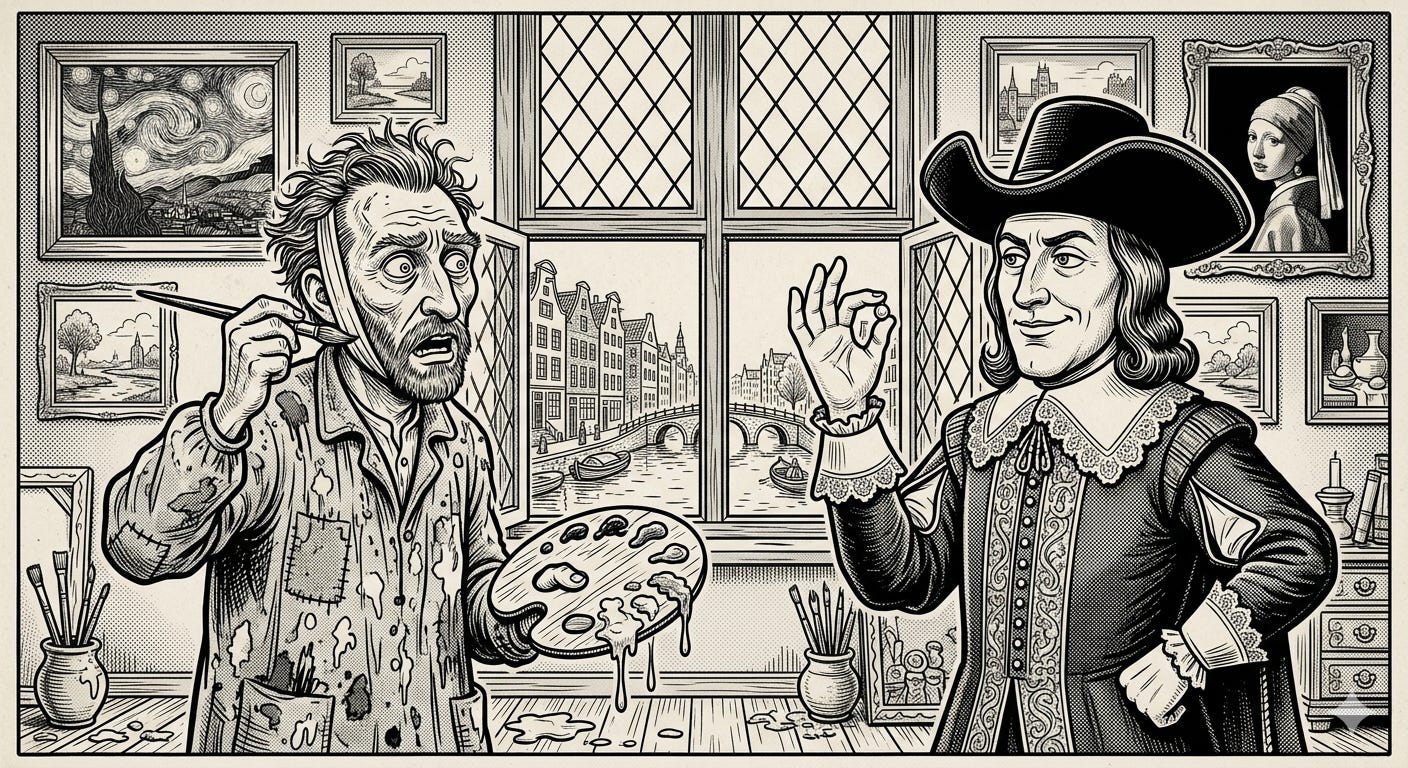
A preface from the author’s wife:
I have lived with Arvind for many years now and have come to master the complexity of his character quite well. Before you read what follows, there is something you should understand about him. He is someone who makes bold, sweeping choices and declares them to the world - not out of ignorance, but as a deliberate act of self-definition. He is perfectly capable of nuance, yet he consciously decides, for himself, whether he likes something or not, and he commits to that verdict completely. His takes will sometimes scandalise you. Actually, scratch “sometimes” - they will always scandalise you. But that is precisely the point: his strong opinions are the lens through which he makes sense of his values and his view of the world. I am taking this stage, by the way, because we are still arguing about whether this piece should exist at all. Read accordingly.
Let us start by dispensing any pretence of balance. Johannes Vermeer of Delft, painter of light, master of silence, conjurer of the infinite within the domestic, stands so manifestly above Vincent van Gogh that comparing the two is less a critical exercise than an act of cartography: one man belongs in the heavens, the other in a field of crows, shouting.
The argument will be made here plainly, without apology, and with the full confidence of someone who has a doctorate in art history - but by someone who hasn’t attended a single course in the social sciences, let alone art history.
The Matter of Light
Vermeer painted light as though he had a private arrangement with it. The cool northern glow that slides through the left-side window in nearly every canvas he produced is not merely observed; it is understood, negotiated, and rendered with a subtlety that no photograph has yet surpassed. The pearl in that famous earring is not painted: it is implied by the light around it, and that implication is more real than most paint on Earth.
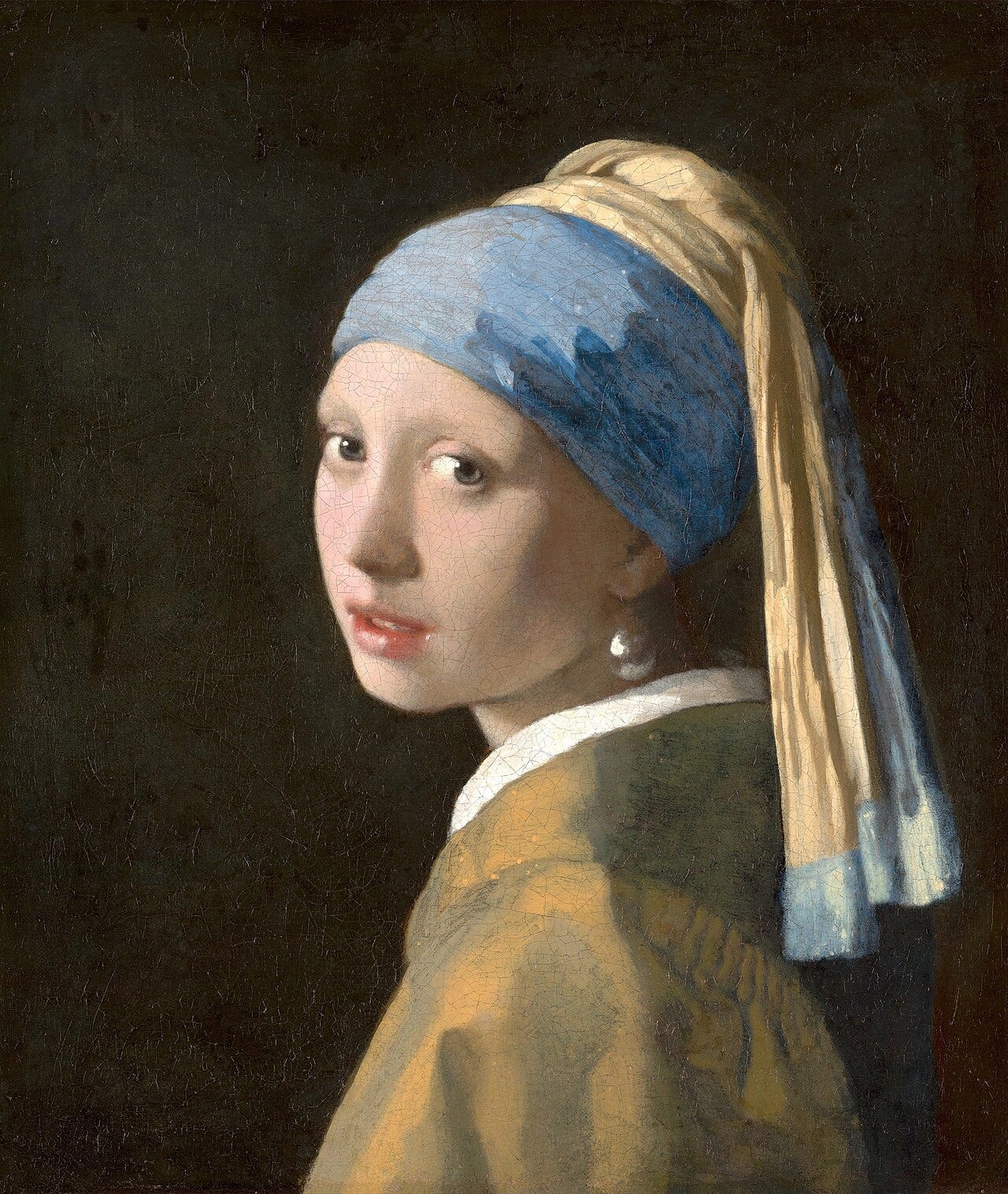
Girl with a Pearl Earring, Vermeer, c. 1665. Mauritshuis, The Hague.
Van Gogh, meanwhile, attacked light with a brush the size of a garden implement. His suns vibrate. His stars spiral. His skies appear to be having some kind of episode. This is called “expressionism” by those who wish to be kind, and “a man who could not stop” by those who wish to be accurate.
The Name Fraud
Let us examine the name “van Gogh” with the scrutiny it deserves.
Vincent was born in Zundert. He grew up in Nuenen. He worked in The Hague, Antwerp, Paris, Arles, and Saint-Rémy. At no point in his life did he live in, work in, paint in, or apparently visit a place called Gogh. Gogh is a small town across the German border. It has nothing to do with him. The “van,” which in Dutch nomenclature traditionally denotes origin, as in from, is therefore not a name so much as a geographical libel. He is not from Gogh. He is from Nuenen. He should, by any honest reckoning, be called Vincent van Nuenen, which would at least have the virtue of accuracy, even if it has rather less of the mystique.
One can only imagine the conversation: “Shall we name ourselves after the turnip village where I painted grim peasants for two years?” No. Better to borrow a German town no one will check.
And the pronunciation! Van Gogh is a name that nobody, in four centuries of trying, has agreed how to render aloud. The Dutch say “van Khokh.” The English say “van Go.” The Americans say “van Goff” and then immediately buy a poster of Starry Night for their university dormitory. The French say something entirely different that we shall not repeat here.
Vermeer. Vermeer. Say it. It resolves. It is complete. It sounds like the sea near Delft at dusk. It sounds like silk. It sounds like a name that knows exactly where it is from, because it is from somewhere worth knowing.
The Dutch Marketing Conspiracy
Here is the secret that the art world declines to discuss openly: Van Gogh’s fame, in substantial part, is a triumph of Dutch national branding, not artistic merit.
Consider the machinery. The Van Gogh Museum in Amsterdam - one of the most visited museums on Earth - was not built because the world demanded it. It was built because the Netherlands needed an export product, and a tortured genius with a dramatic biography and swirling canvases is a far easier sell than 34 quiet paintings of women near windows. The museum opened in 1973. By 1990, Van Gogh was a global industry: calendars, umbrellas, tote bags, chocolate boxes, a Don McLean song. The ear became a logo.
This is precisely the model of Delft Blue, those famous blue-and-white ceramics that the Dutch marketed so aggressively in the 17th century that the entire world came to associate the colour blue with Dutch sophistication. Delft Blue was not the finest ceramic tradition in the world. It was a competent imitation of Chinese porcelain, elevated by extraordinary marketing into a global luxury symbol. Van Gogh is Delft Blue with a paintbrush. The product is genuine enough; the mythology around it is manufactured, exported, and priced accordingly.
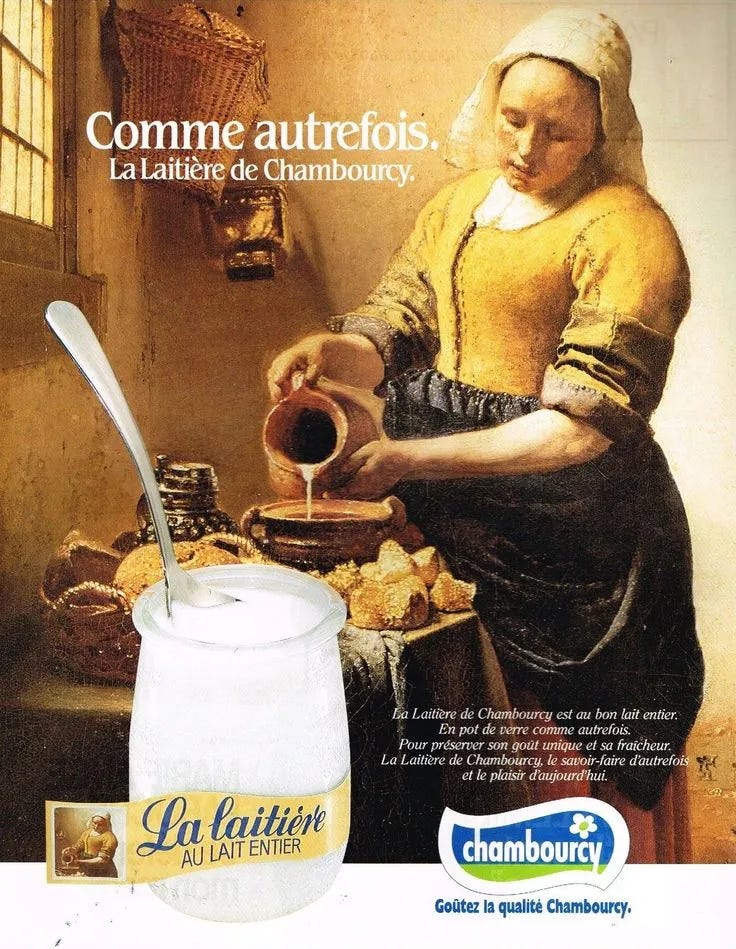
Publicité La Laitière, Danone, 1985. Vermeer’s The Milkmaid (c. 1657), on a yoghurt pot.
Vermeer, meanwhile, required no museum named after him, no merchandise, no biographical drama. He simply made 34 paintings of such completeness that they have been quietly devastating viewers for three and a half centuries without any assistance from the tourism board. In the case of The Milkmaid, his work has been gracing the lids of French yoghurt pots since the 1970s, for which no rights were paid, on account of Vermeer having been dead for three hundred years. He did not complain.
The Economy of Genius
Vermeer produced, by current scholarly reckoning, between 34 to 36 paintings in his entire life. Each of them is a complete universe. The Milkmaid contains more truth about existence, patience, and the weight of a ceramic jug than most artists manage in a lifetime of frenzied production.
Van Gogh produced over 900 paintings, 2000 drawings, and more than 800 letters to his brother Theo, who, one suspects, began dreading the postman.
900 paintings! At some point this is not genius. What we have is a filing problem. Vermeer understood that restraint is not timidity, but confidence: the confidence to stop when the thing is done.
900 paintings! At some point this is not genius. What we have is a filing problem.
Technical Supremacy
Scholars believe Vermeer may have used a camera obscura to achieve his extraordinary geometric precision. His perspective is flawless. His tiled floors recede with mathematical authority. His figures occupy space the way real people do, with weight, with presence, with the sense that if you entered the room they might look up.
Van Gogh’s figures look like they are standing in a wind tunnel made of paint. His technique is called impasto, a word derived from the Italian for “paste,” which rather says it all. There are Vermeer canvases where the paint is so thin and carefully layered that conservators have wept. There are Van Gogh canvases where the paint is so thick it casts a shadow.
The Nuenen Question
Van Gogh spent two years in Nuenen - the village that should by rights bear his name, and one I can confirm is exactly as it sounds, living ten minutes from it - producing dark, grim paintings of peasants eating potatoes by lamplight. This period produced The Potato Eaters, which depicts five people in a state of considerable agricultural hardship, rendered in colours best described as “turnip.”
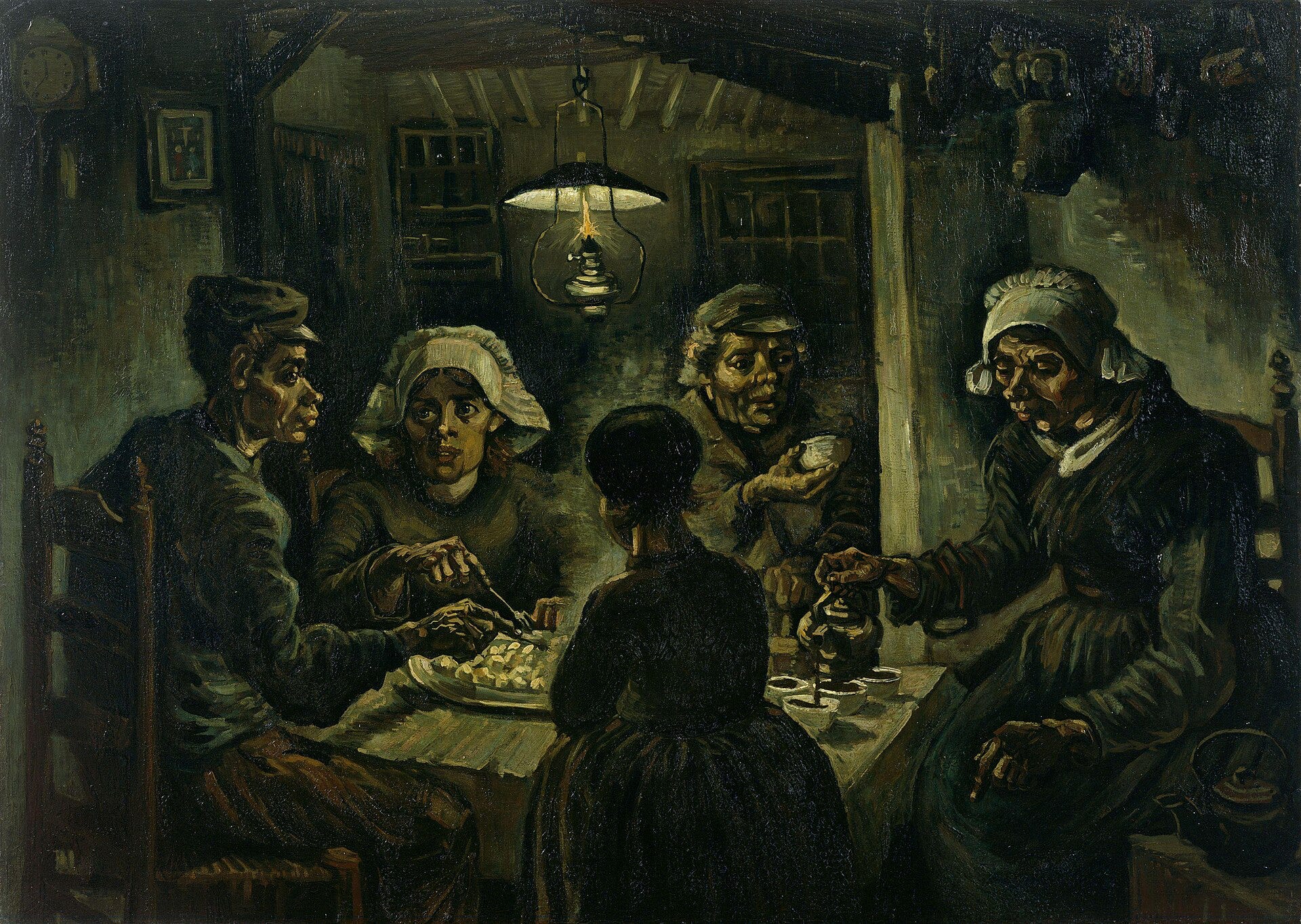
The Potato Eaters, Van Gogh, 1885. Van Gogh Museum, Amsterdam.
Vermeer, for his part, was in Delft, a city of actual canals, actual architecture, actual light, painting women reading letters with expressions of such tender interiority that viewers across three centuries have felt they were intruding on something private. One painter was in a village, surrounded by turnips, misusing a German town’s name. The other was in a city, surrounded by light, with a name that needed no borrowing.
The Posthumous Misfortune
Vermeer was forgotten for two centuries after his death. Entirely. Not diminished, forgotten. And yet, when the critic Thoré-Bürger rediscovered him in the 1860s, the response was immediate awe. The paintings needed no rehabilitation, no re-contextualising, no explanation of why the artist was troubled. They simply worked. Two hundred years of obscurity and they emerged pristine.
Two hundred years of obscurity and Vermeer’s paintings emerged pristine.
Van Gogh’s posthumous fame, by contrast, has become inseparable from the mythology of the suffering artist, the unappreciated genius, the ear. The paintings are loved, but loved alongside the story, the story that the Dutch marketing apparatus has polished to a high shine and sold in forty languages - audio guide included. Vermeer’s paintings require no story. They are their own story, and it is a quiet one, and it is the better kind.
The Verdict
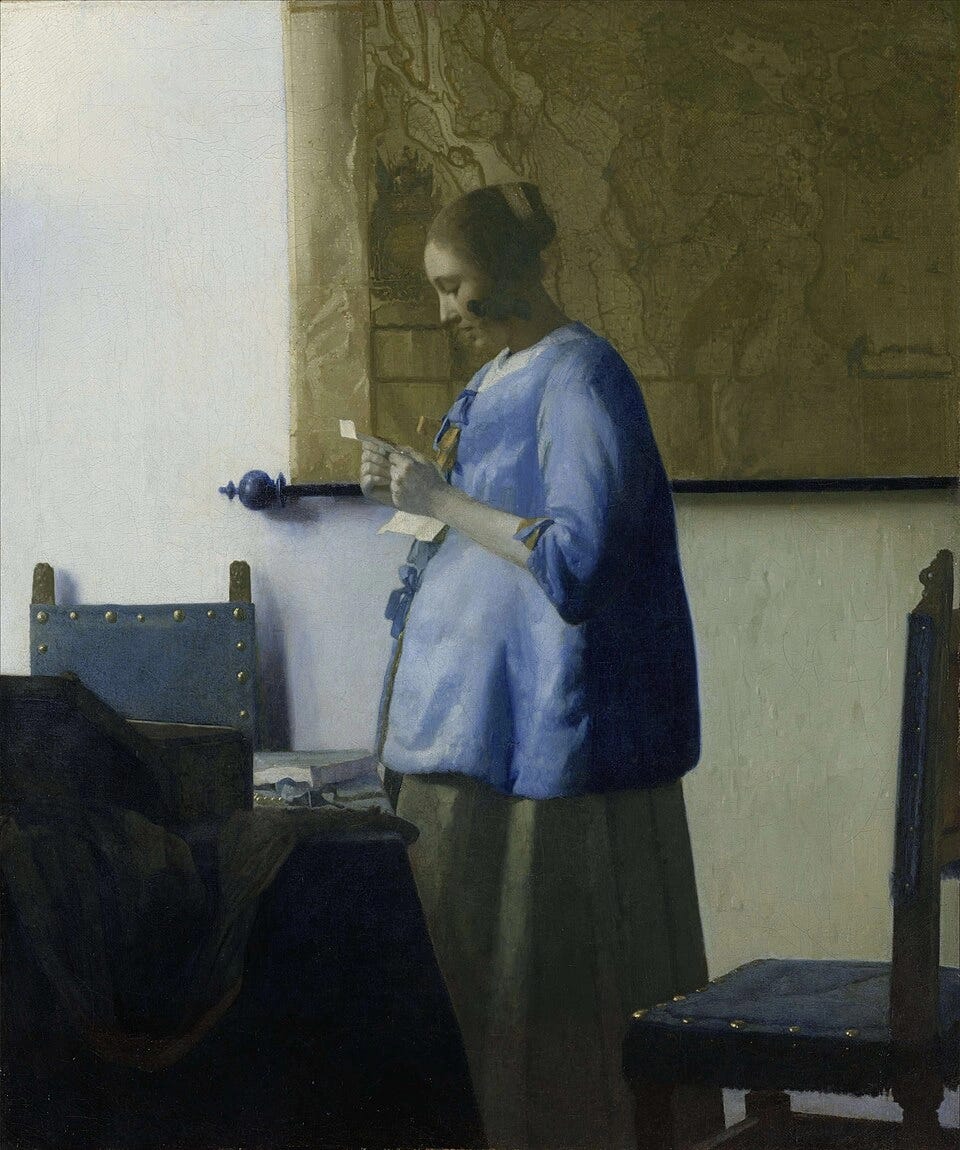
Woman Reading a Letter, Vermeer, c. 1663. Rijksmuseum, Amsterdam.
Stillness is the harder miracle, and the one that requires no marketing budget whatsoever.
Vermeer is superior in technique, economy, poetry, geography, nomenclature, and ear count. Van Gogh gave the world urgency and an effective museum gift shop. Vermeer gave it stillness. And stillness, as anyone who has stood before Woman Reading a Letter can confirm, is the harder miracle, and the one that requires no marketing budget whatsoever.
It is pure blasphemy - all that mudslinging on Van-koff (the French pronunciation that you failed to mention. I don't even know what I am saying) . But I found myself chuckling at various points in this article. Loved the humour. No one has ever ranked artists based on whether their surname accurately reflects medieval Dutch geography. And ear count is also a great way to rank artists.
Loved this: "One suspects Theo began dreading the postman." Talk about empathy :) I would have to rewrite the whole article to highlight what I loved about it!
Penn & Teller turned me on to Vermeer (I so want that documentary to be a true account, even if it turns out not), and I am very happy that I got to see 3 real Vermeer when visiting the Netherlands in 2014