


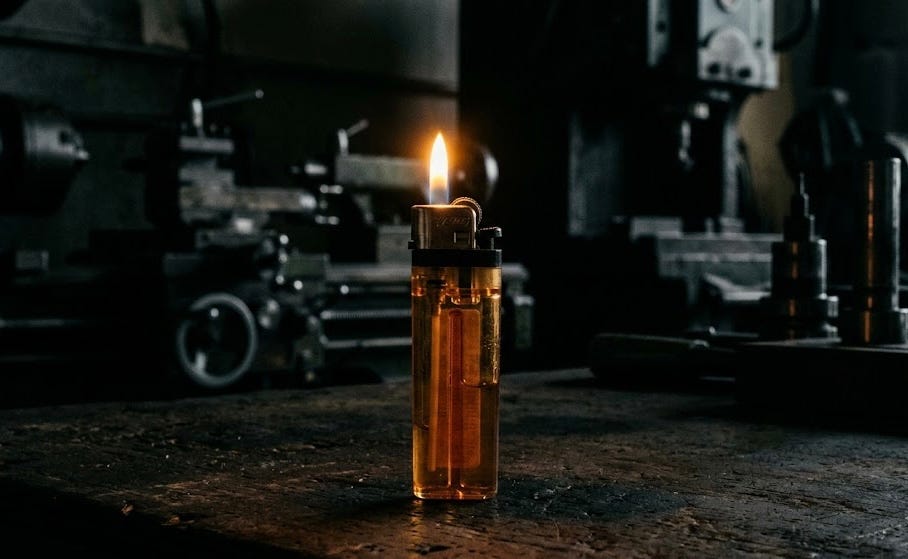
Pick up a disposable lighter. Turn it over in your hand. It is a squat, slightly greasy, usually partially transparent plastic object that costs about as much as a teabag and is treated with roughly the same reverence. You have owned dozens of them. You have lost all of them, mostly to other people who borrowed them and said nothing further on the matter. You were not particularly bothered, because the lighter costs fifteen cents, and another one is always somewhere nearby: in a drawer, on a counter, in the pocket of a jacket you have not worn since last winter.
This is the correct and reasonable attitude to have toward a disposable lighter. It is also completely wrong.
For just 15 cents, you are holding a miniaturised pressurised combustion device. In those 15 cents, you’ve harnessed fire under the subtle will of your thumb. This lighter contains some thirty precision-engineered components. It must withstand sustained internal gas pressure without cracking, leaking, or failing in heat. Its ignition mechanism must survive thousands of friction strikes over its working life. Before it can be sold in most markets, it must pass strict international safety certifications: drop tests, flame height tests, high-temperature endurance tests. It is dropped from 1.5 metres in three different orientations and must survive without leaking. It is baked at 65 degrees Celsius for four hours. Only then does it go into a box.
Then the box goes into a carton. The carton goes onto a pallet. The pallet goes into a shipping container, a container that, because it holds pressurised flammable goods, requires specialist hazardous materials handling and documentation at every point in the logistics chain. The container goes onto a ship. The ship crosses roughly ten thousand miles of ocean. Import duties are paid. A distributor takes a margin. A retailer takes a margin.
Everything: the raw materials, the labour, the machine depreciation, the factory overheads, the ocean freight, the tariffs, and the profit margin of every middleman between the factory floor and your kitchen drawer, squeezed into fifteen cents.
To understand how this is possible, it helps to first understand what the lighter actually has to do.
A small miracle of physics
The disposable lighter solved a specific engineering problem: how do you store enough flammable fuel to produce thousands of lights, in an object small enough for a shirt pocket, at a price low enough that losing it barely registers? The answer is butane, specifically the peculiar thermodynamic behaviour of butane at room temperature.
Butane boils at minus 0.5 degrees Celsius. This single fact is the foundation on which the entire lighter rests. At any temperature above that, which is to say at any temperature at which a human being is likely to be conscious and functioning, butane desperately wants to be a gas. It is only the pressure inside the sealed reservoir that keeps it liquid, forcing the molecules together against their thermodynamic inclinations. At room temperature, that pressure runs to about two or three atmospheres, two or three times the pressure of the surrounding air. The thin plastic shell you are holding is, in the proper sense of the term, a pressure vessel.
This is not nothing. The body must not crack under repeated thermal cycling as the lighter warms in a pocket and cools again. It must not shatter when dropped on concrete. It must not deform enough, at the temperatures one might encounter in a car on a summer afternoon, to allow the valve to leak. The plastic is specifically engineered for this: a combination of polypropylene and nylon chosen for impact resistance, chemical inertness against butane, and the ability to hold dimensional tolerances through injection moulding. The fact that it is transparent enough to show the fuel level and smooth enough to feel cheap and disposable, these are secondary concerns. The primary concern is containment.
When you press the lever, a spring-loaded valve opens. A precisely metered quantity of liquid butane escapes from the reservoir and flash-vaporises almost instantaneously - liquid to gas in a fraction of a second - expanding to several hundred times its liquid volume. The valve is calibrated to release the right amount: enough for a stable, usable flame, not so much that you have briefly created a small flamethrower. This calibration is the kind of tolerance problem that sounds trivial until you try to hold it across billions of units manufactured by dozens of suppliers, and then it is not trivial at all.
If you’ve gotten past figuring out the fuel, and its safe containment - there now remains the small matter of ignition. Before starting the flame, your thumb rolls a serrated steel wheel against a small rod of ferrocerium. Ferrocerium is a synthetic pyrophoric alloy, typically composed of roughly 50% cerium, 25% lanthanum, around 20% iron, and a scattering of other rare earth elements including praseodymium and neodymium. Pyrophoric means it ignites spontaneously on contact with air when divided into sufficiently small particles. The serrated wheel shaves microscopic fragments from the rod, each of which burns in air at somewhere between 1,500 and 3,000 degrees Celsius as it falls through the rising gas cloud. One catches. You have fire.
The whole sequence, depress, vaporise, spark, ignite, takes well under a second. It involves a calibrated pressure vessel, a precision-machined valve, a spring rated to a specific force, a pyrophoric alloy of rare earth elements, and a controlled phase transition. It fits in a shirt pocket. You will lose it before it runs out.
The economics of fifteen cents
Fifteen cents in Europe would barely cover the cost of the metal spring inside.
If you handed a competent Western manufacturing engineer fifteen cents and asked them to produce this object, they would hand the money back. The spring alone requires specific steel alloy, precise wire drawing, careful coiling to a calibrated rate, and heat treatment to set the spring constant. A European spring manufacturer, operating with European labour costs and European energy prices, cannot make that spring for fifteen cents. They cannot make it for fifty cents.
Shaodong makes the whole lighter for fifteen cents and still turns a profit.
That profit is less than one cent per unit. Shaodong is not chasing the gross margins of a semiconductor company or the mystique of a luxury brand. It built a global manufacturing empire on a margin that most businesses would not bother to calculate. This was not an accident or a desperate compromise. It was the strategy, pursued with the kind of systematic rigour that is usually reserved for rather more celebrated industries.
The city of Shaodong in Hunan province, central China, produces around 15 billion lighters per year, roughly 70 to 75 percent of global supply, exported to 120 countries. This is a city that most people outside the lighter trade have never heard of and could not find on a map without some effort. It employs more than 80,000 people in the lighter industry alone, roughly 7.6 percent of the local population. Its largest single manufacturer, Hunan Dongyi Electric, produces between 12 and 13 million lighters per day.
Micro-optimisation at scale
The explanation for how Shaodong does this is not simply “cheap labour”. That story has not been accurate for at least a decade, and the city’s own automation figures make it plain: a production line that once required 200 workers now runs on 40, with nine times the output. What Shaodong has built over thirty years is an industrial cluster of a density and specialisation that is genuinely without parallel for a product at this price point.
The city has 114 lighter manufacturing companies and more than 80 specialist component suppliers, every one of them within a 20-kilometre radius. Ten different towns and subdistricts within the Shaodong area have each specialised in a distinct segment of the production chain: springs here, valves there, casings somewhere else, ferrocerium rods in another village. The entire supply chain for a disposable lighter is available within a 20-minute drive.
They are not shaving costs by the cent. They are shaving them by the thousandth of a cent.
Engineers here redesigned the internal plastic wall of the casing, taking it to the minimum thickness that still held pressure safely, saving a fraction of a penny per unit.
They changed the shape of the lighter’s base so that an additional 100,000 units could be packed into a single shipping container. At fifteen cents apiece, that is fifteen thousand dollars of additional revenue from the same vessel, paying for the same fuel, crossing the same ocean.
Nothing is decorative. Everything that can be optimised has been, and then optimised again.
The labour cost embedded in each lighter has been compressed to 0.015 RMB, approximately a fifth of a US cent. Not per batch. Per lighter. This is the outcome of three decades of iterative micro-optimisation: tooling refined until the reject rate is negligible, assembly sequences redesigned to remove one redundant motion from the line, material specifications tightened until the minimum quantity of brass that can hold the valve tolerance has been identified and is being used, no more.
What makes this level of granular optimisation achievable, and what no competitor can easily replicate, is the proximity of the cluster. When your spring supplier is three kilometres away, quality problems are resolved the same afternoon. When a buyer requests a modified valve profile, a revised sample can be in your hand before the end of the working day. When one factory discovers a cheaper way to form the flint wheel, the knowledge diffuses through the cluster within months, through engineers changing jobs, through suppliers talking to multiple assemblers, through the dense informal network that thirty years of shared industry builds in a small city. This knowledge does not sit in a document. It sits in the heads of the people, in the calibration of the machines, in three decades of accumulated judgement about which supplier is reliable and which one you stopped calling.
The cluster has also learned to customise for markets in ways that are quietly sophisticated. Lighters for European and American buyers are five millimetres wider than the domestic version, because Western hands are larger. Russian-market lighters carry more elaborate decorative tooling on the casing. Indonesian lighters favour moisture-resistant flint mechanisms, because humidity causes battery-powered igniters to short-circuit. These are not large adaptations. They are the accumulated intelligence of decades of sustained attention to what different customers actually do with the product.
Shaodong also invests, unexpectedly for an industry producing fifteen-cent objects, in serious research infrastructure: over 1,000 researchers, an annual R&D budget of around 200 million yuan (approximately $28 million), and an annual product update rate of 38 percent. The research focus is relentlessly practical: constant-flow valves that meter gas more reliably, automated flame-height detection that identifies and rejects non-compliant lighters at line speed, welding processes that produce more consistent seams. This is not glamorous research. It is the research of people who have decided to be, without apology, extraordinarily good at one very specific thing and to push that thing to the absolute limits of what physics and economics jointly permit.
The retail price has not changed in twenty years. Raw material costs have risen. Energy costs have risen. Global shipping costs have risen. The lighter has not noticed.
And at the frontier that Shaodong has established, where every cost has been compressed to its physical minimum and every process iterated to the edge of what the machinery can hold:
No outside competitor can survive. They cannot undercut the price. They cannot match the lead times. They cannot replicate, in a decade, the institutional knowledge that took thirty years to accumulate.
The miracle that doesn’t announce itself
There is a certain kind of engineering achievement that makes itself known. The ASML lithography machine, which etches transistors at scales smaller than a wavelength of visible light. The TSMC fab, where the air is cleaner than an operating theatre and the tolerances are measured in atoms. These things communicate their difficulty. You look at them and something registers: a great deal of hard work went into this.
The disposable lighter does not do this. It looks, and is priced, like something that required no particular effort. That is, in its way, the most impressive thing about it.
The next time you flick one, and it works - as it almost always does - first try, without drama, consider briefly what just happened. Thirty precision components cooperated. A pressure vessel held. A valve metered. A pyrophoric alloy sparked. A phase transition completed in a fraction of a second. And behind all of it - ten thousand miles of ocean, a chain of middlemen each taking their sliver, and an entire city in Hunan province that spent thirty years shaving costs to the thousandth of a cent so that the whole thing, the engineering, the logistics, the profit, clears fifteen cents with nothing to spare. The engineering marvel does not need a cleanroom or a famous postcode. Sometimes it fits in your shirt pocket, and you lose it behind the sofa.