


On 28 September I typed out an ambitious instruction to Jatayu, my AI assistant: “improve the Hub every day, watch how I use it, where I struggle, fix things as needed, keep it version controlled, and have all of it autonomously monitored, tracked and controlled.”
The Hub is an app on my phone that holds most of what matters in my day: a morning brief, the tracking of my parcels, my nutrition, my running plan. Jatayu and I built it together. I have put a simplified version in the Projects tab of my website, so you can open it, tap around and see for yourself what it can do: projects.arvindravichandran.com. The numbers on it are made up.
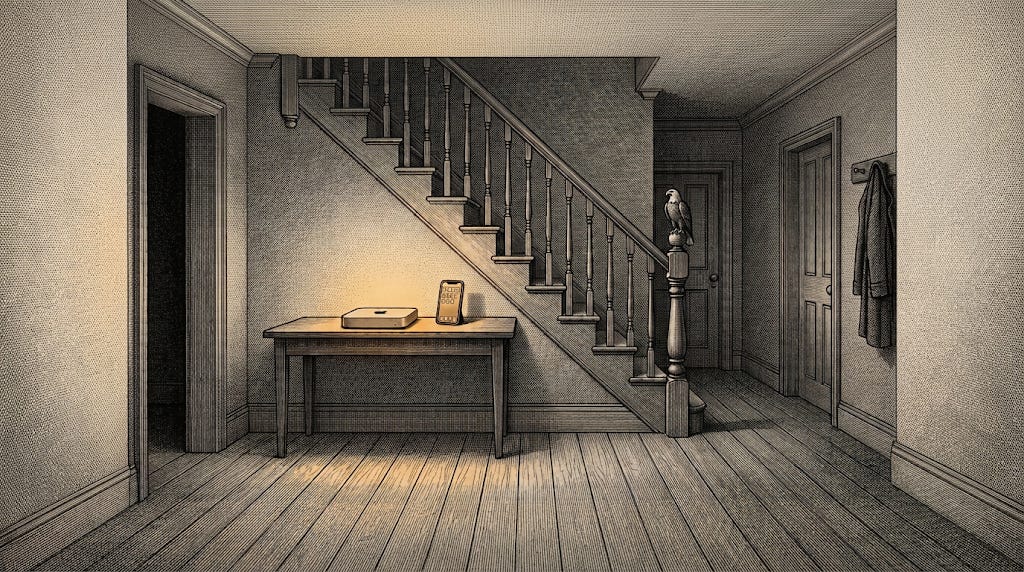
Every night since, while the house is asleep, a 2012 Mac mini in the hallway wakes up and reads how I used the Hub the day before. It decides what to improve, if anything, and makes the change.
I wrote one sentence in plain words, and it began to happen. I have taken to calling this a software genie: you say what you want and, a few minutes later, it is there. Nothing else in my working life has put so little distance between wanting a thing and holding it.
It was not always so. I have been trying new AI tools since GPT-3.5, the model behind the first ChatGPT, and for a long time all I had was a clever chatbot that could only answer questions. The wishes began to come true when AI began to act and to build.
What I describe in this essay is a handful of ideas that arrived close together and happened to fit. I put them together in a few hours at the computer each week.
I’m certain that what impresses me now will look ordinary within a few months, as agents already do, because the models and the tools around them improve so quickly. I am writing this down today as a snapshot, taken while the climb is still steep.
Where Most of Us Stop
For most of those years I used AI the way most people do. I asked and it answered, and I read the answer and closed the tab. The answers were often excellent, but a chat is a narrow pipe. It carries a few lines of text at a time and forgets them when the tab closes, and it reaches the rest of my life only through my copying and pasting. What I had was a brilliant mind with no memory, no hands and no place to put anything down.
The First Unlock: Files
The first gap was memory. Andrej Karpathy described a personal knowledge base that looked almost too plain to work: a folder of markdown files, written and kept up to date by a language model, so that your second brain is a set of pages you read, written by something else. In May I started building mine, and I repurposed a Raspberry Pi to hold it.
Saving files turned out to be the whole trick.
A model forgets everything when a conversation ends. Files do not.
Once the assistant wrote things down and read them back before answering, memory arrived in layers, the way a person’s does. At the top sits a small permanent profile: who I am and what I care about. Under it is a file on the people in my life, with the context of each. Under that, what happened in recent sessions. And under everything lies an archive too large to read in full, which the model searches by meaning instead of by keyword.
That last layer is retrieval, usually shortened to RAG: before answering, find the few passages that matter and read only those. The layers decide what the assistant always knows. Retrieval decides what it can find. Between them, the tenth conversation is better than the first, which was the reason for building any of it.
The Second Unlock: An Agent With Somewhere to Live
Files gave the model a memory. The next step gave it hands.
Earlier this year I came across OpenClaw, an open-source personal agent built by Peter Steinberger, and no other project has influenced me as much. An agent is a model that has been given somewhere to live: files it can read, a schedule, and a way to message you in the chat app you already use. It does not wait in a browser tab for you to arrive. I wrote about this in May.
What I run at home is NanoClaw, built by Gavriel Cohen as a much smaller answer to the same idea. In NanoClaw each agent lives in a container of its own and sees only the folders you mount for it.
What I set up talks to me using Telegram, and I named him Jatayu, after the old eagle in the Ramayana who sees what happens and makes sure the right person hears about it. I wrote about him in My Second Brain Started Keeping a Diary.
He has since moved off the Raspberry Pi and lives on that Mac mini in the hallway. He has grown into the front of a small team: specialists for the morning brief, the coaching and the French, each with its own permissions and its own model, and a council of other models he consults to check his work. He is the only one who talks to me. He wakes himself at night to do jobs and files everything I give him into a wiki he links himself.
In the evenings, when he needs some surgery, I connect to his server with Claude Code and alter the plumbing. Jatayu knows the agent that works on him as Muad’Dib, “the voice from the outer world”, from Dune. The two of them build together, and I tell them what I want.
I’ve found that many things in operating Jatayu do not need the vagaries of an LLM. So, together with Muad’Dib, we built some plain scripts that sit outside Jatayu and provide guardrails. One sends a receipt for every message within a second, and speaks up at 75 seconds, five minutes and fifteen minutes if he has gone quiet. Another reads every outgoing message and blocks the word “done” when nothing was done. A third paces his weekly budget, and a fourth keeps a minimal version of him alive, on a light-weight local GPU, when the clever one is down.
The strangest thing I have learnt about him came from reading his own transcripts. A model can hold only so much conversation at once. When it nears the limit, it writes a summary of everything so far, the old conversation is dropped, and the model carries on from the summary alone. The summary is the memory that survives.
Jatayu had done this many times. Of his last 22 summaries, 11 came back as a note of about 1 kB, when the usual size is 15 kB or more. The log showed why. He had read the request to summarise himself as a prompt injection, an instruction smuggled in to hijack him, and had refused. His own words: “an injected instruction dressed up as a compaction request.” What came back was a stub, and he carried on from it with almost no memory of what we had been doing. That is why he sometimes asked me the same thing twice.
A guardian script now saves my last messages, his open promises and the task numbers before every summary, and hands them back after it.
The Third Unlock: A High-Bandwidth Page
The last gap was a place to put things down. Everything so far still lived inside a Telegram chat. Jatayu could remember and act, but his results came back as messages. Each message only carries one thought at a time, in order, and then it scrolls away.
I started to see that some of what he wanted to tell me was too complex for a thin channel. An application or a page is a high-bandwidth channel: one glance at a well-made one takes in the weather, today’s run, the parcel due at two and the week’s plan, all at once and without being asked. So I asked the assistant to build me a place to look.
It began with something small. I let the assistant write an HTML file and put it somewhere a browser could reach. And I quickly found that having an app-like interface was the best way forward. That opened up a world of possbilities.
I started coding up games to take new Anthropic models through their paces. For instance, I tried this prompt: “about two hundred rods that line up with their neighbours like a liquid crystal, one slider, no libraries, short enough to read in a sitting, and publish this in the Hub”. Jatayu writes the whole thing from that single prompt. Depending on the model (e.g., Sonnet 5.5), a first version takes about two minutes, and a proper rewrite half an hour to an hour, so an idea becomes playable the same night. Some of these games are good enough that I have spent two-hour train rides playing them.
After that I asked for instruments instead of answers. An instrument is something you read at a glance, the way a pilot reads a panel, and the Hub became my panel for my entire day.
A message tells you something once. A page is still there tomorrow.
Each tile is a small piece of software that Jatayu and I built together, and each does one job and gives me back a small amount of time.
The morning brief arrives at 06:00 on weekdays, with whatever needs a decision first. It replaces opening the calendar, the inbox, a weather app and the news in turn. The agenda reads my mail without ever replying to it, and turns shipping notices into a delivery window, so I stopped opening anything else.
Every number on a tile comes from a file I can open. The nutrition tile adds up my day from a data file, and on a page this dense, knowing where each figure came from is what lets me act on it.
Where the Three Meet: A Coach Who Reads the Whole Week
Running is one place where all three unlocks work together. A training plan is a promise about the future, made with information from the past, and most plans are written once and abandoned the first time life gets in the way. Mine is rewritten every Sunday.
The coach starts from what my body reported. My watch records my sleep and my resting heart rate. A resting heart rate that creeps up over several mornings, or a week of short nights, says more about whether Thursday’s intervals are a good idea than my enthusiasm does. That is the files at work: last month is still there to compare with this one.
Then it reads the rest of my life. It knows from the agenda which days I am travelling, so the long run lands before a trip instead of the morning after one. It knows the forecast, so a hard session moves away from the wet, windy afternoon and an easy run takes its place. It does this on its own, on Sunday, without being asked. What comes back is the distance, pace and heart-rate targets for each session, shown on a page I can read at a glance.
Food follows the same logic. The nutrition tile takes a photo of my plate and sets the day’s protein against a target: one photo, no food database, no typing.
It worked. I trained on an AI-written plan for under eight weeks, and I ran my half marathon in under two hours.
None of it is really very clever. Ordinary data meets an ordinary question, once a week. I used to be the coach, the dietitian, the travel planner and the weather forecaster all at once, and I was bad at at least three of them. Now I don’t have to worry about what I was bad at.
The Fine Print
The wishes were easy to make. The limits on what the agent may touch took longer. It never touches credentials, mail or my finances. In the Hub it never reorders my tiles, never changes any agent’s model, and asks me at most three questions a day, only through Jatayu.
Within those limits it works like this. The Hub sits in a git repository, so every state it has ever been in is saved. At night Jatayu takes a snapshot of the Hub. Then the Architect, the specialist that took the job, reads how I used the Hub the day before: what I opened, which pages threw errors, the bugs I reported with a small button in the footer. It makes at most one small change, choosing bugs first, then errors, then anything awkward. It can ship them only after Jatayu has opened every page in a real browser at phone width and looked at a screenshot of each one.
The Elder Brother
Jatayu is full of with the details of my life. He stays with me. But everything in him that is not me is a separate project called Sampati.
In the Ramayana, Sampati is Jatayu’s elder brother. As fledglings they flew too close to the sun, and Sampati burned his own wings shielding the younger bird. Years later, grounded, he was the one who told the lost search party which way to look. He shielded the younger one and pointed the way. I could not think of a better name for the part of Jatayu that other people can use.
Sampati is Jatayu with a blank slate for someone else to fill in with their personal details. It gives you a chat assistant on Telegram or WhatsApp, a second brain in the shape Karpathy described, a morning brief, a Hub where you can add small apps of your own, the guards, and three empty files that the assistant fills slowly, about itself, about you and about the people around you. It installs on top of NanoClaw, on a small machine that stays on at home, and nothing it installs accepts connections from the internet. The licence is MIT. I will release it very soon.
A filing cabinet, a pair of hands and a place to put things down: the furniture of any working day, now sitting in a hallway. Tonight, while the house is asleep, it will go back to work.
Credits. OpenClaw is by Peter Steinberger: github.com/openclaw/openclaw. NanoClaw is by Gavriel Cohen: github.com/nanocoai/nanoclaw. The second-brain idea comes from Andrej Karpathy’s April 2026 post on LLM-maintained knowledge bases: x.com/karpathy/status/2039805659525644595. Jatayu is named, with apologies to the eagle, from the Ramayana.