


There is a particular quality of consciousness that only illness can produce. Not the dramatic delirium of high fever, not the clean blank exhaustion of surgical recovery - but something subtler and stranger. The state of being moderately, thoroughly sick: throat stripped raw, nose producing mucus at an industrial rate, breath running hot as an engine idling too hard. In this state, thought is possible, but it moves differently. Freed from the tyranny of productivity, stripped of the usual ambient hum of tasks and obligations, the feverish mind slides into a lateral, associative mode that philosophers might generously call contemplative and that everyone else would call lying on the sofa staring at the ceiling.
It was in precisely this state that I found myself doing arithmetic about viruses.
The question that surfaced was this: if I could, by some magic, reach into my own body and extract every single viral particle causing this misery, compact them into a ball between my index finger and thumb, how large would that ball be? It is not the kind of question a healthy person asks. But under the gauze of infection, with the metabolic overhead of an immune response running hot across every tissue, it felt like the most natural and urgent question in the world. The answer, when worked out, is genuinely startling. And the less magical versions of the idea - the ones actual science is beginning to inch toward - are more interesting still.
The arithmetic of an invasion
A 2021 paper by Sender et al., published in the Proceedings of the National Academy of Sciences (PNAS), addressed exactly this question for SARS-CoV-2. By integrating measured viral genome concentrations across the tissues of the respiratory, digestive, and immune systems, the authors estimated that a person at peak infection carries somewhere between one billion and one hundred billion individual viral particles. Extreme cases, they note, might reach ten trillion. The characteristic peak, the middle of the distribution, sits around ten billion.
Ten billion virions. Now: how large is each one? Respiratory viruses - rhinovirus, influenza, SARS-CoV-2 - are roughly spherical, with diameters in the range of 80 to 160 nanometres. Call it 120 nm. The volume of a single virion is therefore approximately 9 × 10⁻²² cubic metres. Multiply by ten billion particles, account for the fact that randomly packed spheres fill roughly 64% of available space, and the total volume of your entire viral load comes to somewhere in the region of 14 cubic millimetres.
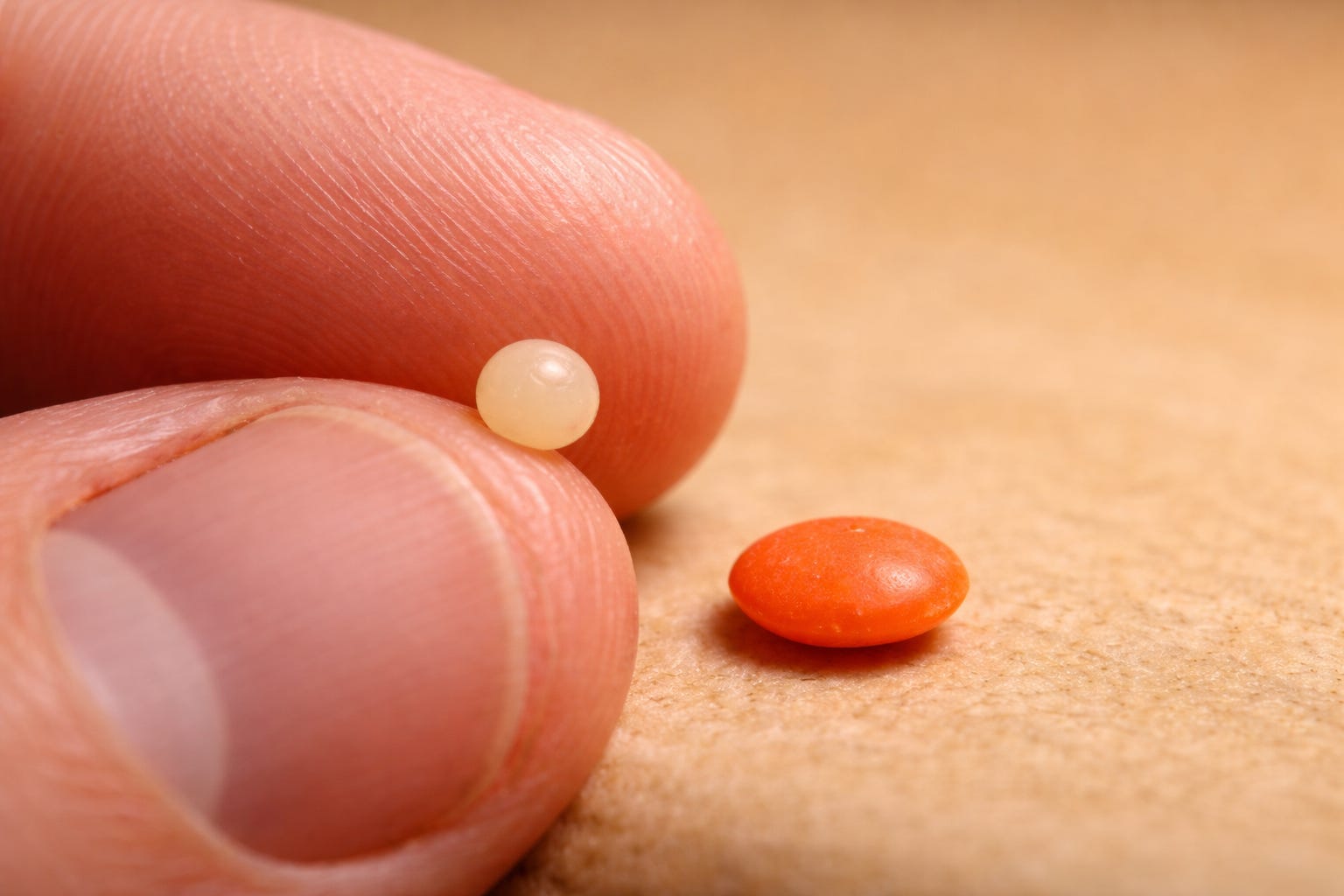
Fourteen cubic millimetres. A sphere of that volume has a diameter of just under 3 millimetres. A small lentil. The head of a moderately fat pin. You could tuck it under a fingernail and it would not noticeably protrude.
The entire army that has reduced you to a hot, mucus-producing wreck for the better part of a week - the entity responsible for your cancelled meetings, your missed workouts, your two days horizontal watching the ceiling - occupies a volume smaller than a grain of red lentil.
The mass of this lentil of misery is even more astonishing. Each virion has a mass of approximately one femtogram. Ten billion of them weigh around ten micrograms - a tenth of a tenth of a milligram. Your body's entire pathogen load, at the peak of infection, would not register on a kitchen scale. And yet your immune system has mobilised every system it has - fever, inflammation, neutrophil cascades, antibody production, cytokine storms - to eliminate it.
The asymmetry is almost philosophically disturbing. A few nanograms of RNA wrapped in lipid membranes, and the entire biological infrastructure of a human body - 37 trillion cells, the product of 600 million years of evolution - is brought to its knees.
The texture of this viral booger
Now imagine you could dry this thing out and hold it. What would it feel like between your fingers?
Viral capsids are tightly packed assemblies of capsid proteins, arranged in the repetitive, geometrically precise symmetry that electron microscopes have made famous. The lipid envelopes of influenza and SARS-CoV-2 are phospholipid bilayers lifted directly from the membranes of the host cells they destroyed on the way out. Dry, the lipid fraction would feel waxy, faintly greasy - think the residue left on your finger after touching a candle, but at the scale of a lentil. The protein fraction would be brittle, chalky, somewhere between dried egg white and the powdery residue left by evaporated biological fluid. The whole thing would crumble if you pressed it too hard. It would have no smell you could detect - the quantities are simply too small - but biochemically the material would be pungent stuff at scale: oxidised lipids, denatured structural proteins, fragments of RNA. Something like rancid butter crossed with the inside of a used tissue, mercifully presented to your nose in a quantity below the threshold of perception.
If you remove the viruses, what next?
Posit the impossible: a mechanism that could cleanly extract every virion from your tissues, aggregate them, and remove them in a single gesture. And then, for good measure - you fold it in a paper towel, and whack it to death with a hammer in the shed. What happens?
The immediate consequence is the termination of viral replication. Viruses do not replicate in free space - they hijack host cellular machinery. Without active virions, there is no further production of progeny. The source is gone.
The cascade that follows is rapid. Your immune system is not simply reacting to viral particles; it is responding to a continuous stream of molecular signals - pathogen-associated molecular patterns detected by toll-like receptors, cytokine gradients, interferon signalling. Remove the antigen and this signalling rapidly degrades. The cytokine-driven fever, which exists because interleukin-6 and prostaglandin E2 have reset the hypothalamic thermostat upward, begins to resolve within hours as the pyrogen source disappears. The furnace throttles down.
Your mucus production - an active immune mechanism containing secretory IgA antibodies, lysozyme, and inflammatory mediators - tapers over a day or two. The sore throat, the product of local inflammatory activity across your pharyngeal epithelium, resolves as the stimulus for it disappears.
But here is the genuinely interesting part. By the time you feel terrible enough to register as properly ill, your adaptive immune system has already been working for days. Memory B cells have been generated. T-cell clones specific to viral epitopes have expanded. The antibody titres are rising. Extracting the virus does not reset this - those immunological records are written into the long-lived cells of your lymph nodes and bone marrow. You would walk away from the extraction not just recovered, but immune, without having endured the full week of misery that natural clearance requires.
Same immunological outcome, compressed into hours rather than days. The war ends by removing the battlefield rather than winning it.
Less magical approaches: What science is actually attempting
As much as I would like, in the misery of this wretched illness, the technology to remove viruses like a nasal booger doesn't exist. Or so I thought. I found four different viral clearance techniques - grounded in serious science - that come quite close to achieving exactly this outcome.
Broad-spectrum antiviral nanoparticles that directly disrupt viral envelopes; engineered monoclonal antibodies that tag virions for rapid immune clearance; soluble receptor decoys that neutralise viruses by mimicking their cellular targets; and extracorporeal filtration systems that literally pull viral particles from the blood. Each represents a different strategy for shortening the war - ending the infection not by outlasting the enemy, but by making the battlefield disappear.
Medicine has always been, at its core, the art of doing faster what the body would eventually do anyway. These four approaches are that instinct taken to its logical extreme - not waiting for the immune system to win the war, but reaching in and ending it.
Broad-spectrum antiviral nanoparticles
The most structurally analogous real-world approach involves nanoparticles engineered to interact directly with virions - not to deliver drugs to infected cells, but to physically interfere with the particles themselves. A 2023 review in ACS Pharmacology and Translational Science catalogued the growing evidence that metallic nanoparticles - silver, copper, zinc oxide, gold - can inhibit a wide range of viruses through mechanisms increasingly well understood at the nanoscale. Silver nanoparticles in particular have attracted substantial research attention: their antiviral action against influenza, RSV, and SARS-CoV-2 involves direct binding to and disruption of viral envelope proteins, preventing cell attachment and entry.
What makes this approach structurally interesting is that it does not depend on viral specificity the way conventional antivirals do. Oseltamivir (Tamiflu) works on influenza neuraminidase; it is useless against rhinoviruses. A nanoparticle that disrupts lipid envelopes non-specifically can in principle work against any enveloped virus. The challenge is delivery - getting sufficient concentrations into the nasal mucosa and upper respiratory epithelium without systemic toxicity - and selectivity, since viral membranes and host cell membranes are chemically similar. Not a solved problem, but a tractable one. Inhaled nanoparticle formulations for respiratory viral infections are in active development.
Antiviral monoclonal antibodies
A more targeted approach uses broadly neutralising monoclonal antibodies, engineered to bind to conserved regions of viral surface proteins - regions that mutate slowly because they are structurally essential to the virus - and flag the virion for immune clearance. Modern monoclonal antibodies can be engineered to bind with extraordinary affinity to specific viral epitopes, crosslinking to Fc receptors on macrophages and neutrophils that then consume and destroy the opsonised virion.
The practical limitation for acute respiratory infections is timing. These therapies are most effective early, before peak viral load, when the viral kinetics are still ascending. By the time you feel the full force of symptoms, viral load in most infections has already reached its maximum and is beginning to decline naturally. The therapeutic window is narrow and tends to close precisely when people feel sick enough to seek treatment. The vision is a rapid point-of-care antigen test that identifies the infecting virus within minutes of first symptoms, triggering immediate administration of a matched or broad-spectrum antibody cocktail. Every component of this technology exists. The system-level integration does not, yet.
Viral decoys: receptor mimicry
A more elegant approach, still largely at the research stage, uses soluble receptor decoys. Respiratory viruses bind to host cells by latching onto specific surface receptors - ACE2 for SARS-CoV-2, sialic acid residues for influenza. Flood the respiratory tract with a soluble, engineered version of that receptor, and virions bind to it preferentially rather than to cell-surface receptors, neutralising themselves without immune involvement. The virus cannot easily escape this by mutation, because any mutation that reduces decoy binding also reduces receptor binding, and a virus that cannot bind its receptor cannot replicate. Soluble ACE2 was explored during the COVID-19 pandemic in exactly this role, and showed promise in early-stage models.
Extracorporeal viral filtration
The most literal approach is extracorporeal therapy: passing blood outside the body through a filter designed to capture and remove virions, analogous to dialysis for toxin removal. A column of functionalised beads coated with viral-binding ligands - antibodies, receptor fragments, aptamers - could in theory reduce circulating viral load dramatically in a single pass. This approach has been explored for sepsis and HIV. For respiratory viruses it is complicated by the fact that most of the viral load sits in tissue rather than blood, but the concept is sound. For a critically ill patient with overwhelming viral infection, it could do what no drug does: physically reduce the antigen burden faster than the immune system alone can manage, preventing the runaway cytokine response that kills not the pathogen but the host.
The scale problem, reconsidered
Return to the lentil. Three millimetres. Roughly one part in twenty million of your total body weight. Yet your immune system devotes enormous resources to finding and destroying it. The fever alone costs a 10 to 12.5 percent increase in metabolic rate per degree Celsius - an overhead that, for a moderate fever sustained over several days, represents a non-trivial caloric expenditure. Appetite falls away, a deliberate immune-metabolic strategy to redirect glucose from muscle to immune cells. The net result is weight loss, fatigue, and the particular hollowed-out sensation of post-infection recovery.
All of this for a lentil. The disproportion between cause and effect is not a flaw in the immune system’s design - it is an architectural necessity. The immune system cannot see the lentil. It can only see the signals: the molecular flags that virally-infected cells wave, the cytokine gradients forming across infected tissue, the antibodies bound to viral surface proteins in the blood. It must infer the enemy from its footprints, and it must respond not to the current state but to the projected trajectory. If these ten billion virions replicate unchecked for another 24 hours, there will be ten trillion. The response is calibrated to the threat that would exist without it, not the threat that currently exists.
This is also why the fantasy of extraction is so appealing from a sick-bed. Not just because it would end the suffering immediately, but because it would make the disproportionality visible. It would show you the thing you are fighting. Here it is, between two fingers: the entire cause of a week of misery, a slightly waxy, chalky pellet the size of a lentil, weighing nothing at all.
A virus is an information packet. A few thousand nucleotides of RNA encoding the instructions to make more of itself, wrapped in a protein coat. The mass is almost irrelevant. What matters is the information, and the information’s ability to commandeer your cellular machinery. Fighting a virus is not a war of masses. It is a war of protocols.
The mucus itself - that most unglamorous symptom - is in part a mass grave. It contains viral particles, the dead and dying remnants of your own epithelial cells killed by viral replication or by your immune system's friendly fire, the neutrophil extracellular traps cast like molecular nets to snare pathogens, and the immunoglobulins secreted by plasma cells in the mucosal lining. You are blowing out the debris of a battlefield.
The body is not failing. It is spending enormous resources, running hot, to fight something it cannot see, guided entirely by molecular signals, using weapons refined across hundreds of millions of years of evolutionary pressure. It is doing this on your behalf, without asking, without instruction, and - if you are otherwise healthy - it will win. The fantasy of extraction comes from the same impulse that drives all of medicine: the desire to short-circuit the body’s slow, expensive, painful processes with something faster and more direct. We have spent centuries doing exactly this, with increasing sophistication.
The next frontier - direct viral clearance, engineered decoys, neutralising nanoparticles, extracorporeal filtration - is the logical continuation of that trajectory. The lentil, eventually, will not require a week to extract. It will require an afternoon.
Until then - Fluids. Rest. Another tissue. blows nose