


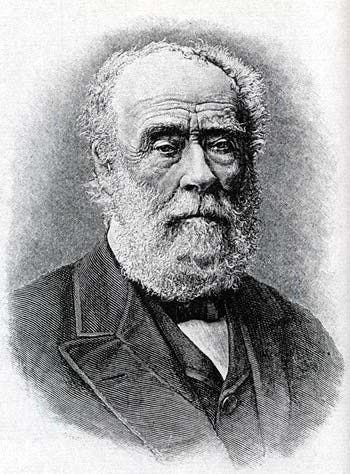
Sir John Whitworth - An engraving from a photograph made by Elliot & Fry, London 1882
You are assembling flat-pack furniture. At some point the supplied bolt strips, or you lose it behind the sofa cushion, or it simply isn’t there. A factory somewhere in Sweden made an error of omission and you are now one bolt short of a functional bookshelf. You rummage through your toolbox. You find an M6 bolt rattling around at the bottom, origin completely unknown. Could be from a bicycle repair. Could be from a shelf bracket you put up five years ago. Could have come with an appliance that no longer exists in your home.
You press it against the IKEA nut. You turn it. It bites immediately.
Of course it does. It always does. You have never once in your life worried that it wouldn’t.
That moment of complete non-anxiety is the subject of this essay.
Physics of Nuts and Bolts
The bolt that found its way into your toolbox and the nut that came in a flat-pack from a warehouse in Älmhult did not know each other. They were made by different people, in different countries, possibly in different decades. And yet they cooperated immediately.
This is because they share a geometry. The M6 metric thread has a diameter of 6 millimetres, a pitch of 1 millimetre between each thread, and a flank angle of 60 degrees. Every M6 bolt in the world has these numbers. Every M6 nut in the world expects them. The agreement is total and invisible and completely taken for granted. Let’s take a deeper look.
When the threads engage, they do not touch along their full surface. Contact happens only at the flanks - those narrow angled faces on either side of each thread crest - in lines so fine they are nearly theoretical. The clamping force that eventually holds your bookshelf to its base is born from almost nothing. Almost nothing that turns out to be somehow more than enough.
As you turn the bolt, the helix is doing something that Archimedes understood. A thread is an inclined plane wrapped around a cylinder, and an inclined plane trades distance for force - a modest rotational effort becomes enormous pressure at those contact lines. It holds because the threads are trying to slide against each other and cannot quite manage it. A controlled stalemate, maintained by friction and geometry.
Tighten it further, and something rather beautiful happens. The head of the bolt is pressing down against the surface, and the nut is pulling the threaded shaft upwards towards it. The bolt is being tugged from both ends simultaneously. Steel is elastic at these scales, and so the shaft stretches lengthways, along its own axis, by a few thousandths of a millimetre. You cannot feel this. You cannot see it. But that elongation means the bolt is now behaving like a very stiff spring, trying to return to its original length, pressing the thread flanks together. That stored tension is what keeps the friction stalemate alive through vibration, temperature change, and years of being ignored.
Two pieces of metal, touching along lines you cannot see, holding together a bridge, an engine, a ship.
Before the Language Existed
This was not always the case.
For most of the Industrial Revolution, a bolt made in one workshop would not fit a nut made in another. Every machinist cut threads to his own standard, by feel, by habit, by the particular geometry his master had taught him, which was itself the geometry his master had taught before that. A broken machine in the field could not be repaired with parts from a different manufacturer. A factory that grew beyond one man’s oversight discovered that its left-hand machines and its right-hand machines spoke entirely different dialects. Two workshops that wanted to collaborate on a single project had no shared vocabulary for this tight, this angle, this many threads per inch.
The result was not merely inconvenient. It was a hard ceiling on what could be built. You could not build something larger than what one workshop could hold in its head.Into this situation came Joseph Whitworth. A man from Manchester. A man who, if the Jeremy Clarkson documentary (Inventions that changed the world: Gun) is to be believed, had the face of a disgruntled primate. A man who spent his entire working life being irritated that nothing fit together properly, which turns out to be an excellent qualification for the job he eventually did.
In 1841, Whitworth presented a paper to the Institution of Civil Engineers. He had surveyed workshops across Britain, measured their thread standards, and proposed something radical in its simplicity: one angle, 55 degrees. One set of thread pitches, correlated to diameter. The same everywhere. Always.
The metric standard that eventually became dominant settled on 60 degrees rather than 55. The precise number mattered less than the fact of agreement. That was always the point.
The helix was ancient. The bolt was ancient. What Whitworth contributed was the agreement.
What the Agreement Made Possible
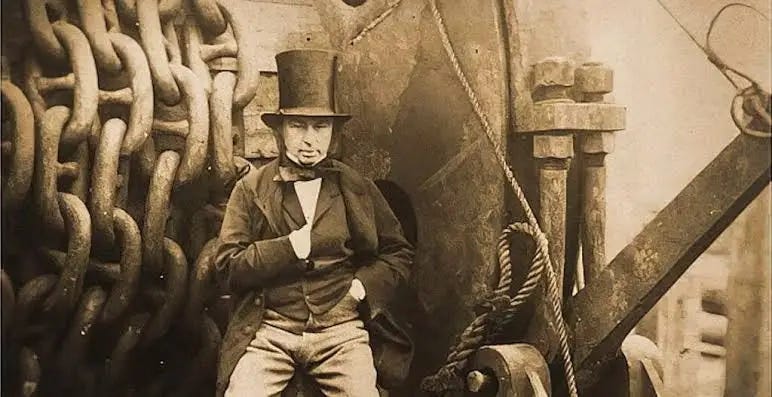
Isambard Kingdom Brunel (1857, photo by Robert Howlett)
Isambard Kingdom Brunel was already building things that should not have been possible. The SS Great Britain, launched in 1843, was the first ocean-going ship with an iron hull and a screw propeller. It was assembled by hundreds of craftsmen across dozens of workshops who had never met each other and never would. Brunel could not supervise every joint. Nobody could.
What made it possible was that he did not have to. The standard supervised it for him. A bolt specified on a drawing in Bristol would be cut in Sheffield and arrive in a Bristol dockyard ready to meet its nut without ceremony or adjustment. The agreement between two pieces of metal was an agreement between the men who made them, none of whom needed to be in the same room.
This is what Whitworth actually did. He did not solve an engineering problem. He gave engineers a shared language. And once they had it, they could build things that no single engineer, no single workshop, no single mind could have produced alone.
The railway network. The steamship. The suspension bridge, the skyscraper, the aircraft, the rocket. None of these are the work of one man. All of them depend, somewhere in their structure, on two pieces of metal agreeing on an angle.
The Invisible Foundation
There is a version of history that gives the credit for the Industrial Revolution to the visionaries. To Brunel with his ships and tunnels and railways, to Watt with his steam engine, to the men whose names appear on the things they built.
Whitworth does not appear on anything. His name is not on a bridge. His standard is not visible in any machine. He left behind a condition: the one under which things could be built at all. That kind of contribution is almost impossible to see, and almost never credited. The visionary gets the monument. The man who ensured that every bolt the visionary specified would actually fit its nut gets, at best, a mention in a documentary, followed by a remark about his resemblance to a baboon.
But pull any thread of modern engineering and you arrive, eventually, at an agreement. A standard. A shared number that nobody questions because everybody uses it. The tolerance that a chip manufacturer holds across ten thousand wafers. The communication protocol that allows a radio in Tokyo to speak to a satellite built in California. The thread angle on the bolt in your toolbox that came from nowhere and fit perfectly.
Someone decided those numbers. Someone had to.
The next time a bolt bites immediately, without a second thought, consider briefly the man who made that possible. He changed everything.
Thank you for this. I discovered your substack today and this was the first piece I read, it was a wonderful read. It’s wild to think that the ultimate measure of Whitworth’s success is that he became somewhat invisible. We are still building off of the invisible architecture of people who forced us to agree on the angles.
https://pointieststick.com/wp-content/uploads/2026/02/xkcd-digital-infrastructure.png
This one hits close to home. As an aircraft mechanic, I live inside the world Whitworth helped create. Every bolt, nut, washer, cotter pin, torque value, thread pitch, tolerance, and part number represents an agreement made long before I ever touched the aircraft. A fastener manufactured years ago by one company can be installed today by a mechanic in Korea, using a manual written somewhere in the United States, and everybody involved understands exactly what that piece of hardware is expected to do. When the system works correctly, nobody gives it a second thought. The bolt fits, the torque wrench clicks, the inspection is signed off, and the aircraft flies.
What I especially appreciate about this article is the recognition that “boring” is often the highest compliment in maintenance. We do not want creativity when selecting aircraft hardware. We want repeatability, traceability, standardization, and complete agreement between the drawing, the technical manual, the part, and the mechanic performing the work. The spectacular machine gets the attention, but its safety depends on thousands of ordinary components quietly conforming to standards. Aviation is built on that invisible language. The aircraft may be impressive, but the real miracle is that all its parts agree with one another.