


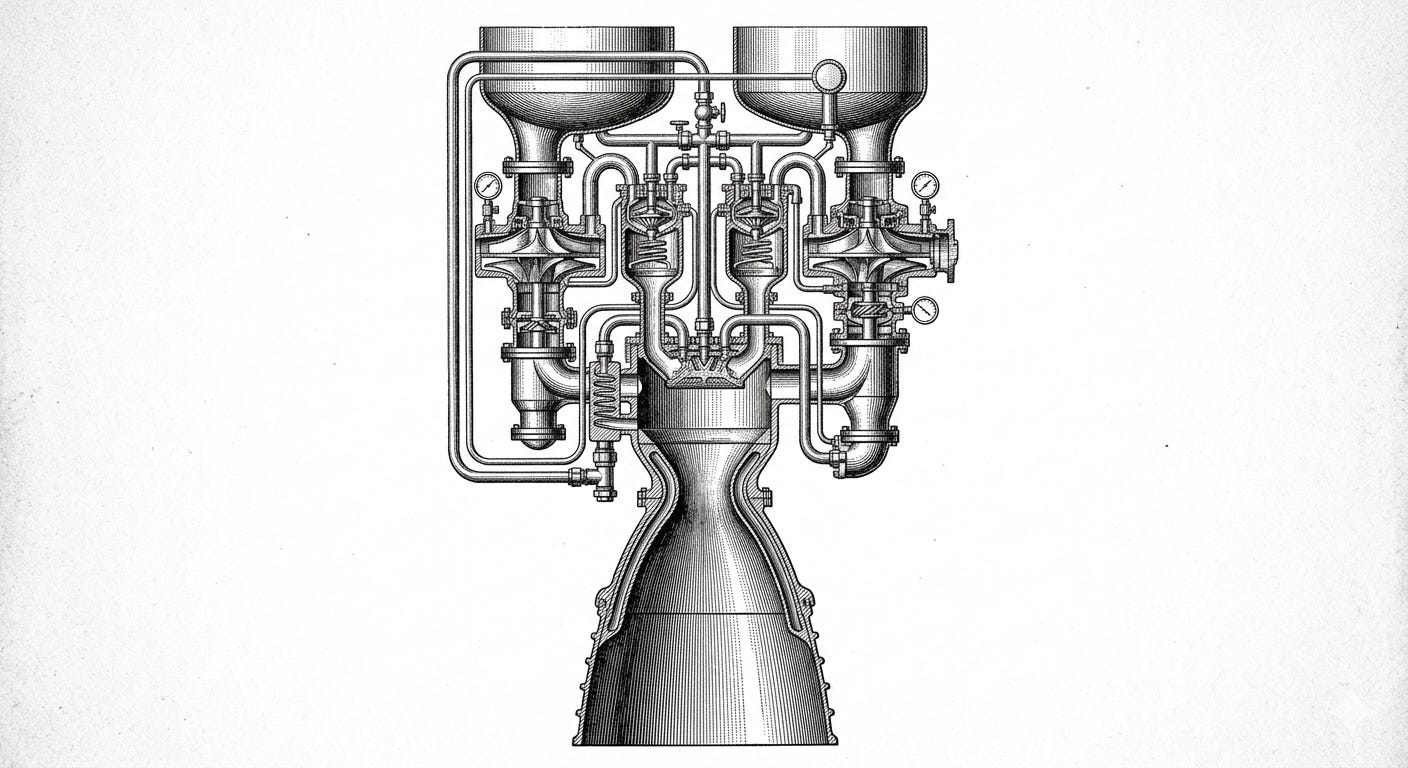
The Raptor engine, the motor powering SpaceX’s Starship rocket, burns its propellants at a chamber pressure of 350 bar.
For comparison: the atmospheric pressure at sea level - the weight of the entire air column above you, pressing down on every square centimetre of your skin - is 1 bar. The pressure at the bottom of the Mariana Trench is roughly 1,000 bar. Raptor operates at more than a third of that. Inside a combustion chamber roughly the size of a large cooking pot, methane and liquid oxygen are meeting and reacting at pressures that would crush an unprotected submarine hull.
This is not an incidental engineering fact. It is the whole point. The pressure is why Raptor exists. And to understand why anyone would want to build an engine that operates under those conditions, you have to start somewhere earlier, with a simpler question: what is a rocket engine actually trying to do?
The Fundamental Constraint
A rocket engine has one job: burn propellant, produce hot gas, push that gas out the back as fast as possible. The faster the exhaust moves, the more thrust you get per kilogram of propellant burned. Simple in principle. Brutally constrained in practice.
All combustion needs two things: something that burns, and something that makes it burn. In a rocket, these are called the fuel and the oxidiser. Raptor uses methane as its fuel and liquid oxygen - LOX - as its oxidiser. Mix them under pressure, ignite them, and you get an extremely hot, extremely fast expansion of gas. That gas exits through the nozzle at the bottom of the engine. The rocket goes the other way. This is the whole mechanism. Everything else is about doing it as efficiently as possible. And it’s also where the fun begins.
The measure of efficiency in rocketry that engineers use is called specific impulse. Think of it as fuel economy - not in kilometres per litre, but in how much thrust you can wring from each kilogram of propellant each second. A car engine that goes further on the same tank of petrol has better fuel economy. A rocket engine that produces more thrust from the same propellant has higher specific impulse. Higher is always better: better fuel economy means you can carry less fuel for the same mission (a lighter, cheaper rocket), or carry more payload and go further on the same fuel (a more ambitious mission).
The question, then, is what sets the ceiling on specific impulse. The answer is pressure.
Hot exhaust gas expands through the nozzle - that conical bell shape at the bottom of every rocket engine - and that expansion is what converts heat into velocity. The denser and hotter the gas when it starts expanding, the more velocity you can extract from it. Higher chamber pressure means denser gas at the start of the expansion. Denser gas at the start means faster exhaust at the end. Faster exhaust means more thrust per kilogram of propellant.
Pressure, in short, is efficiency. Which raises an immediate question: if pressure is so good, why not just have more of it?
Pressure, in short, is efficiency.
The answer is that pumping hundreds of litres of propellant every second into a high-pressure chamber is very hard work. It is so hard that you almost need another rocket engine just to push the fuel in.
That second engine, in effect, is the turbopump - an extraordinary machine that spins at tens of thousands of RPM and moves hundreds of kilograms of cryogenic fluid per second against enormous resistance. Those turbopumps need to be driven by something. And different rocket engine designs are just different answers to that one question.
There is one version of this rocket engine which, at least on paper, gives you the highest specific impulse. That’s called Full Flow Staged Combustion. The holy-grail of rocket engines.
Four Answers to One Question
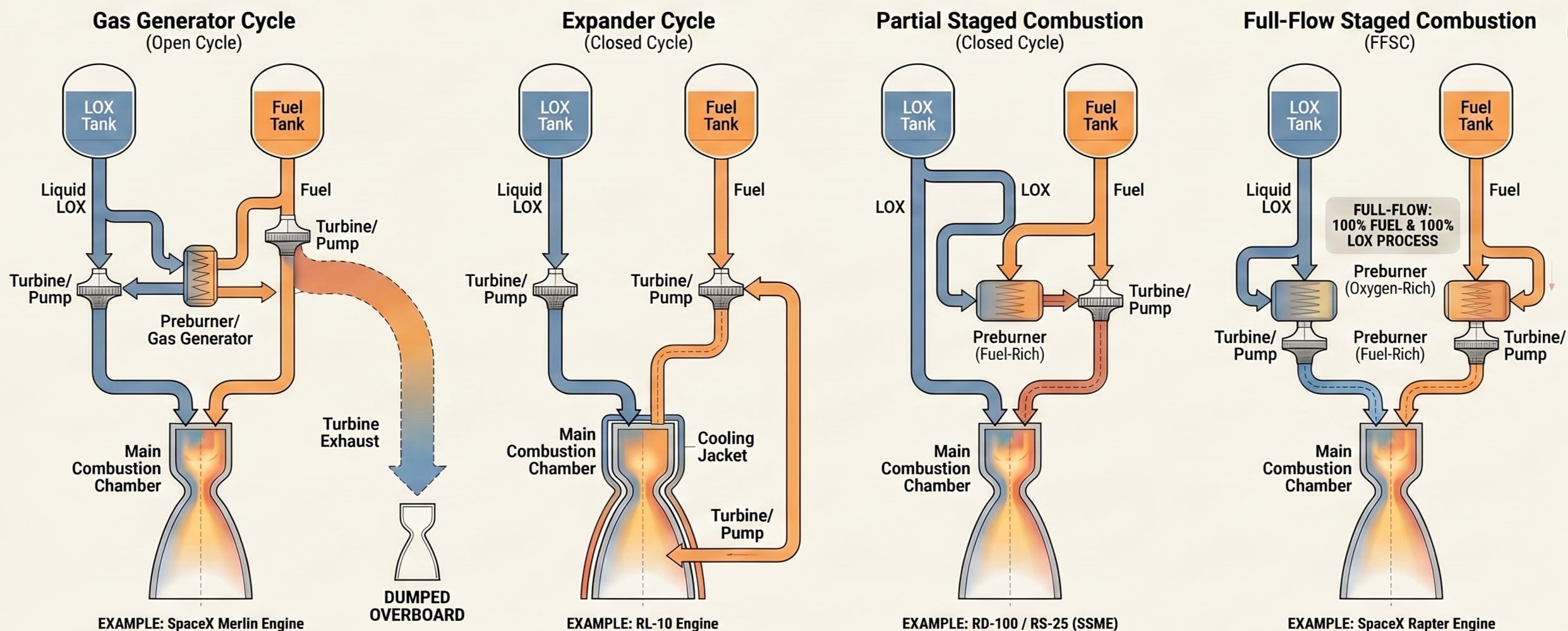
Figure 1: Four rocket engine designs to solve the fuel pumping problem
Gas Generator Cycle
The simplest answer is the gas generator cycle. You tap a small fraction of your propellant - a few percent - burn it at lower pressure in a separate chamber, use the hot gas to spin your turbopumps, then dump the exhaust overboard. It works. It is reliable. The F-1 engine that carried Apollo to the Moon used a gas generator. The Merlin engines on the first-generation of SpaceX’s Falcon 9 use one too.
The problem is waste. That exhaust you dumped overboard still had energy in it. It contributed nothing to thrust. You paid for those turbopumps entirely in wasted propellant.
Expander Cycle
The expander cycle takes a more elegant path. Instead of burning propellant to drive the turbopumps, you use the waste heat absorbed by the engine’s cooling jacket. Cryogenic propellant runs through channels around the combustion chamber, gets heated by the engine it is trying to cool, and the resulting expansion drives the turbines. No propellant is wasted; it all eventually goes through the main combustion chamber.
The limitation is power. You can only extract so much heat from the cooling circuit, which caps how hard you can drive the pumps, which caps chamber pressure. The RL-10 (developed in the 1950s by Pratt & Whitney) was one of the finest upper-stage engines ever built. It uses an expander cycle and operates at around 40 bar. Elegant but ultimately modest.
Staged Combustion Cycle
The staged combustion cycle is the serious answer. You burn a portion of your propellant in a preburner, use the hot gas to drive high-power turbopumps, then route the entire exhaust into the main combustion chamber where it combusts again. Nothing is dumped overboard. All the energy eventually becomes thrust. This allows much higher chamber pressures - the Soviet RD-180 uses staged combustion and operates at around 260 bar.
But conventional staged combustion still makes one compromise: only one propellant goes through the preburner. The other bypasses it, going straight to the main chamber. It is manageable. It is also not the ceiling.
Full flow staged combustion refuses the compromise.
The Full Flow Cycle
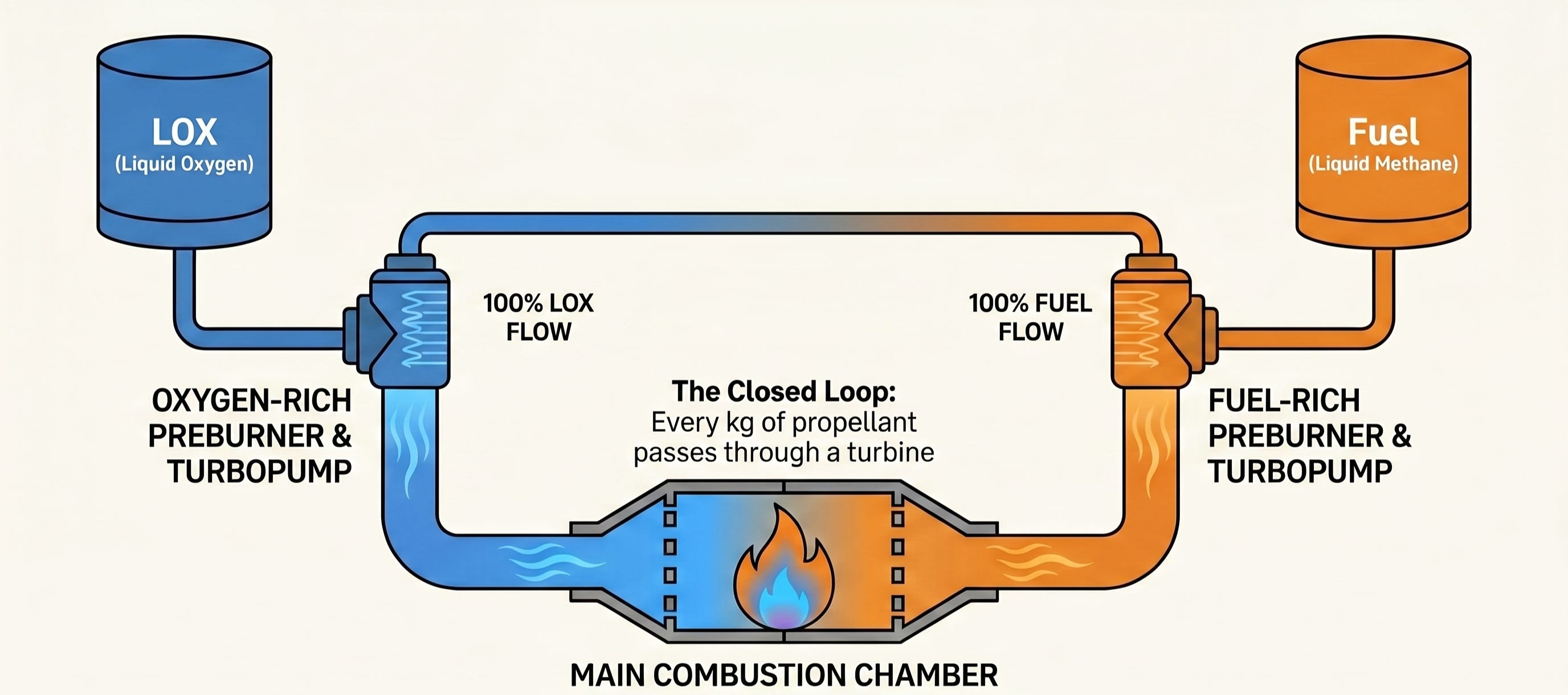
Figure 2: Full flow staged combustion requires both propellants to go through their own preburners
In a full flow staged combustion engine, both propellants go through their own preburners before entering the main combustion chamber.
There is a fuel-rich preburner, where a small amount of oxidiser burns with most of the fuel. The hot, fuel-rich gas drives the fuel turbopump. There is an oxidiser-rich preburner, where a small amount of fuel burns with most of the oxidiser. The hot, oxidiser-rich gas drives the oxidiser turbopump. Both exhaust streams then flow into the main combustion chamber, where they combust completely. Every kilogram of propellant contributes to driving the pumps. Nothing is wasted or bypassed.
What this buys you is extraordinary pump power, which translates directly into chamber pressure, which translates into efficiency. The thermodynamic loop is closed as completely as chemistry allows.
Which raises the obvious question. If this cycle is so clearly the best, why did it take sixty years and one company to fly it?
The Problem That Buried an Empire
An oxidiser-rich preburner burns propellant in a mixture that is oxygen-heavy. The exhaust is hot and contains free oxygen - reactive, aggressive, eager to combine with anything around it.
Including the engine itself.
Metals oxidise. This is not normally a problem because most combustion environments are fuel-rich: the oxygen is consumed by the fuel before it can attack the engine walls. An oxidiser-rich environment reverses this. You are, in effect, asking metal components to survive in a continuous slow burn. At the temperatures and pressures involved in a rocket preburner, “slow” is a relative term.
The Soviets understood this problem in the 1960s. Valentin Glushko - the most gifted rocket engine designer the Soviet programme produced, and one of the most underacknowledged figures in the history of propulsion - was pursuing full flow staged combustion for the RD-270 programme. The engine was intended for the UR-700, a rival architecture to the N1 moon rocket. Glushko’s instincts were correct: the full flow cycle was the right answer.
The oxidiser-rich preburner would not co-operate. The metallurgical solutions available in the 1960s could not reliably contain it. The RD-270 never flew. The N1 programme, which used a different architecture and different engines, failed catastrophically four times and was quietly cancelled. The knowledge Glushko had accumulated about oxidiser-rich combustion was classified, buried in Soviet technical literature that Western engineers could not access.
For decades, the engineering consensus in the West was that an oxidiser-rich preburner was essentially impossible. Not merely difficult: it was categorically off the table. The corrosion problem had no solution.
What the consensus was actually saying, without knowing it, was that the problem had no solution yet. Materials science continued advancing. Computational fluid dynamics made it possible to model combustion instabilities that were previously only discoverable by blowing up test hardware. New nickel superalloys and thermal barrier coatings changed the metallurgical envelope.
The ceiling did not move. But the floor rose up to meet it. Enter Elon.
Elon Chooses the Ceiling
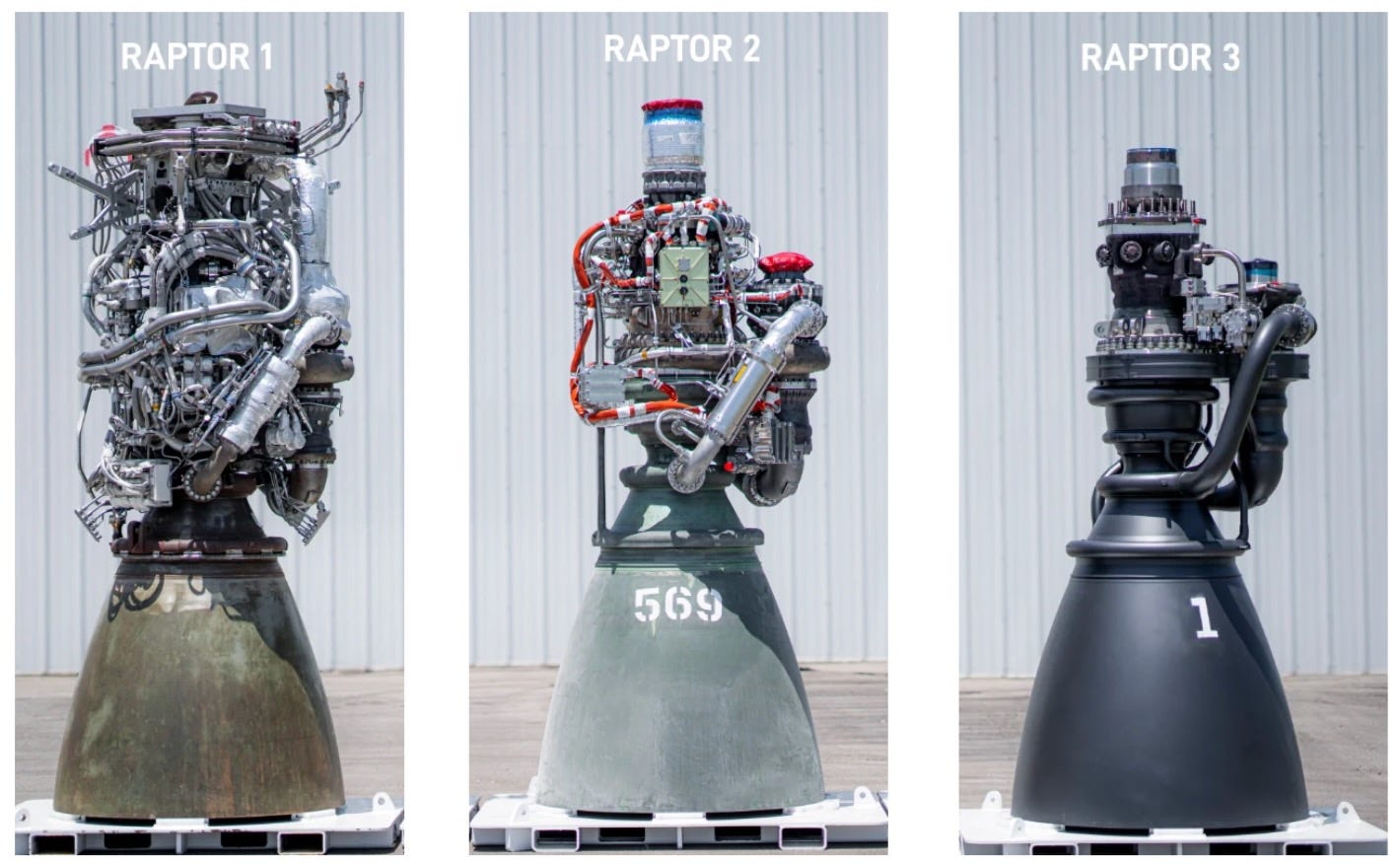
Elon Musk’s stated goal is the colonisation of Mars. Not a visit. Not a flag-planting exercise. A self-sustaining civilisation on another planet. That ambition sets the engineering requirements directly: you need an engine so efficient, so reusable, and so manufacturable at scale that flying to Mars becomes less like a moon shot and more like a long-haul flight. There is only one thermodynamic cycle that comes close to those requirements. It had never flown in the West. SpaceX chose it anyway.
When SpaceX began developing Raptor, full flow staged combustion had flown on exactly one engine type: the RD-270’s successors in the Soviet programme, which themselves had limited operational history and whose detailed engineering was not freely available.
The choice of cycle was a deliberate bet. The Raptor programme was not trying to build a good engine. It was trying to build the thermodynamically optimal engine for a methane-LOX architecture, because the long-term mission - cargo and crew transport to Mars - required the best possible efficiency. Every improvement saved propellant. Saved propellant meant more payload per launch. More payload per launch meant a Mars mission that was economically possible rather than theoretically conceivable.
The oxidiser-rich preburner problem had to be solved, so it was solved. The solution involved new alloys, precise mixture ratio control at the preburner injector, and careful management of temperature: if you can keep the oxidiser-rich exhaust cool enough, the corrosion rate drops to acceptable levels. The RD-170 family were oxidiser-rich, partial staged combustion engines. They flew, and they worked. The Russians sold them to the Americans in the 1990s when they were cash-strapped. These engines had already demonstrated that oxidiser-rich staged combustion was possible if not straightforward. Raptor extended the principle to both sides of the propellant system simultaneously.
Three seconds of choreography
The engineering problems compound. A full flow engine has two preburners, each of which must be ignited in the correct sequence, each of which must reach stable combustion before the main chamber can light. The startup transient - the window between ignition and stable operation - passes through a landscape of potential instabilities. Combustion is not a smooth process: it is a continuous negotiation between fluid dynamics, chemical kinetics, and the geometry of the injector. At high pressures, instabilities that would be damping at lower pressures can couple to acoustic modes in the chamber and amplify. An engine that works at 100 bar may destroy itself at 200 bar via a resonance that did not exist before.
This is why the history of rocket engine development is so full of unexplained explosions. The instabilities are often discovered by experiencing them.
The startup sequence alone is a feat of choreography. Both preburners must ignite in a precise order - fuel-rich first, to condition the turbopumps before full oxidiser flow begins. Valves open in a carefully timed cascade, each step contingent on the last reaching stable pressure before the next begins. The whole sequence, from first ignition to full thrust, takes roughly three seconds. In those three seconds, the engine passes through dozens of intermediate states, each of which could, if the timing is wrong, produce a pressure spike, a combustion disturbance, or a hard start - an explosion caused by propellant pooling before ignition catches. The engine is controlled by an onboard computer running a closed-loop algorithm that monitors chamber pressures hundreds of times per second and adjusts valve positions in real time. There is no human in that loop. It happens too fast.
What 350 bar Actually Buys You
Back to the simple idea: a rocket engine’s job is to turn propellant into thrust as efficiently as possible. Raptor’s 350 bar delivers efficiency that no hydrocarbon engine has achieved in flight before.
What does that actually buy you? Consider the journey to Mars. Getting there requires accelerating a spacecraft to a particular speed, then decelerating it on arrival. Every drop of fuel spent accelerating is fuel that has to be carried from Earth. The more efficient your engine, the less fuel you need, which means a lighter ship, which means a smaller rocket, which means you might actually be able to afford to build the thing. Or - running the equation the other way - the same rocket can carry a much larger payload. More food, more equipment, more redundancy, more chance of survival.
Consider what happens when you make a rocket slightly more efficient. The engine needs less propellant to reach the same speed. Less propellant means a lighter vehicle. A lighter vehicle needs even less propellant to accelerate. That saving feeds back into itself, round after round, all the way from the launchpad. This is the rocket equation - and it is brutal in both directions. A small improvement in efficiency does not produce a small improvement in payload. It produces a large one. Raptor’s efficiency advantage over the best kerosene engines is modest on paper. What it buys you on the way to Mars is not modest at all.
A small improvement in efficiency does not produce a small improvement in payload. It produces a large one.
And then there is reusability.
The Thousand-Flight Engine
The Starship architecture is designed for full and rapid reuse - not the partial reuse of Falcon 9, where the first stage returns and the upper stage does not, but genuine full-stack reuse where both vehicles land, are refuelled, and fly again. If full-flow staged combustion wasn’t hard enough, this is what makes Starship one of the greatest engineering undertakings in human history.
The economics of this depend on propellant being cheap relative to hardware. Methane, unlike kerosene, can potentially be synthesised from Martian atmospheric CO₂ and subsurface water ice - a process SpaceX calls in-situ resource utilisation, and which is the difference between a one-way outpost and a self-sustaining colony.
The full flow cycle turns out to be unusually well suited to this. Because both propellants combust completely - nothing is dumped overboard, no fuel-rich exhaust vented - the combustion is cleaner than in any previous cycle. Less coking, less residue, less unburnt carbon accumulating on injector faces and chamber walls. In a gas generator engine like the Merlin, the turbine exhaust leaves a film of partially combusted hydrocarbons across internal surfaces that has to be cleaned between flights. Raptor, running at full flow, largely avoids this. The same thermodynamic logic that makes it efficient also makes it durable. High volume manufacturing is only meaningful if the engines you manufacture can fly again quickly - and the full flow cycle, almost incidentally, makes that easier.
For that model to work, you want every flight to be as propellant-efficient as possible, because the bottleneck on Mars is not money but energy for synthesis. The more efficient the engine, the less propellant each flight requires. The less propellant each flight requires, the faster the cadence that a given synthesis capacity can support. The thermodynamic cycle, optimised to a ceiling, enables a logistics model that would be impossible with a merely good engine.
Elon Touched the Ceiling
Glushko saw the ceiling in 1967. He built toward it. The materials failed him, the programme was cancelled, and the knowledge was buried. For half a century, the ceiling sat there, acknowledged by anyone who understood propulsion theory, approached by no one in the West, approached but not reached by the Soviets.
The full flow cycle was not a secret. The thermodynamic argument was not hidden. Any engineer who sat down with the equations could derive why it was the optimal answer. They just could not build it, and after enough attempts failed, the engineering culture calcified around the belief that it could not be built.
What SpaceX did was not discover a new principle. The principle was known. What they did was refuse to accept the cultural conclusion that had been drawn from the failed attempts. They treated the oxidiser-rich preburner not as a category error but as an engineering problem - difficult, expensive, demanding of new materials and new methods, but tractable.
Raptor flies. The chamber pressure is 350 bar. The efficiency is among the highest ever achieved by a full-flow hydrocarbon engine. The cycle that Glushko reached for, across the Cold War and the space race and the collapse of the Soviet programme, is now running in an engine designed to carry people to Mars.
The thermodynamic ceiling was always there. The physics never changed. What changed was that Elon decided the ceiling was worth touching, and had enough time, money, and tolerance for combustion instability to find out whether he was right.
He was right.
Interesting article. This is a bit of a tangential question, but does the pressure allow for gauging fuel and oxidizer levels in low gravity? I recall a research question from some time ago, so possibly outdated, about how to determine remaining levels of liquid anything in low gravity.
Very good