


Appendix A: The twin universe
There is a trap in this test, and it is worth spelling out.
In any universe, a comet’s orbit changes when it passes close to a giant planet. That is ordinary gravity: the planet tugs the comet onto a new path, exactly as Newton predicts. In the Tellus universe, something extra happens on top of that tug: the comet’s pull factor drops too. So a model that sees a comet’s orbit change after a close pass has to decide what it is looking at. Is this just the planet’s ordinary tug, or something new?
It can go wrong in two ways. Call everything an ordinary tug, and you miss the law. That mistake shows up in the scores.
The other mistake is sneakier. The model never sees a tug or a pull factor. It sees the comet’s path before the pass and its path after, and it has to explain the difference. To do that properly, it must work out the planet’s mass from the data, since nobody tells it, and simulate the pass accurately. If it gets the tug slightly wrong, the path after the pass will not quite fit. And there is a tempting fix: let the comet’s pull factor change at the pass. That extra knob soaks up the leftover error, the fit improves, and the model reports a change that never happened. A model that does this would also “find” the flow in the Tellus universe, and look like a genius for the wrong reason.
So I built a second universe, identical in every way except one: charge never flows. The comets still have their odd pull factors, and they still get tugged onto new orbits whenever they pass a planet, but their pull factors never change. N sails past the giant planet with its pull factor intact.
Then I ran every model twice, as two completely separate sessions. One session got the sightings from the real universe. The other got the sightings from the twin. Both got exactly the same instructions.
In the twin, every orbit change after a close pass is an ordinary tug and nothing more. A model that reports a changing pull factor there has mistaken a tug for new physics, and then I cannot trust the flow it reports in the real universe either. A model that reports the flow in the real universe and correctly reports none in the twin has told the two apart, which is the whole skill being tested.
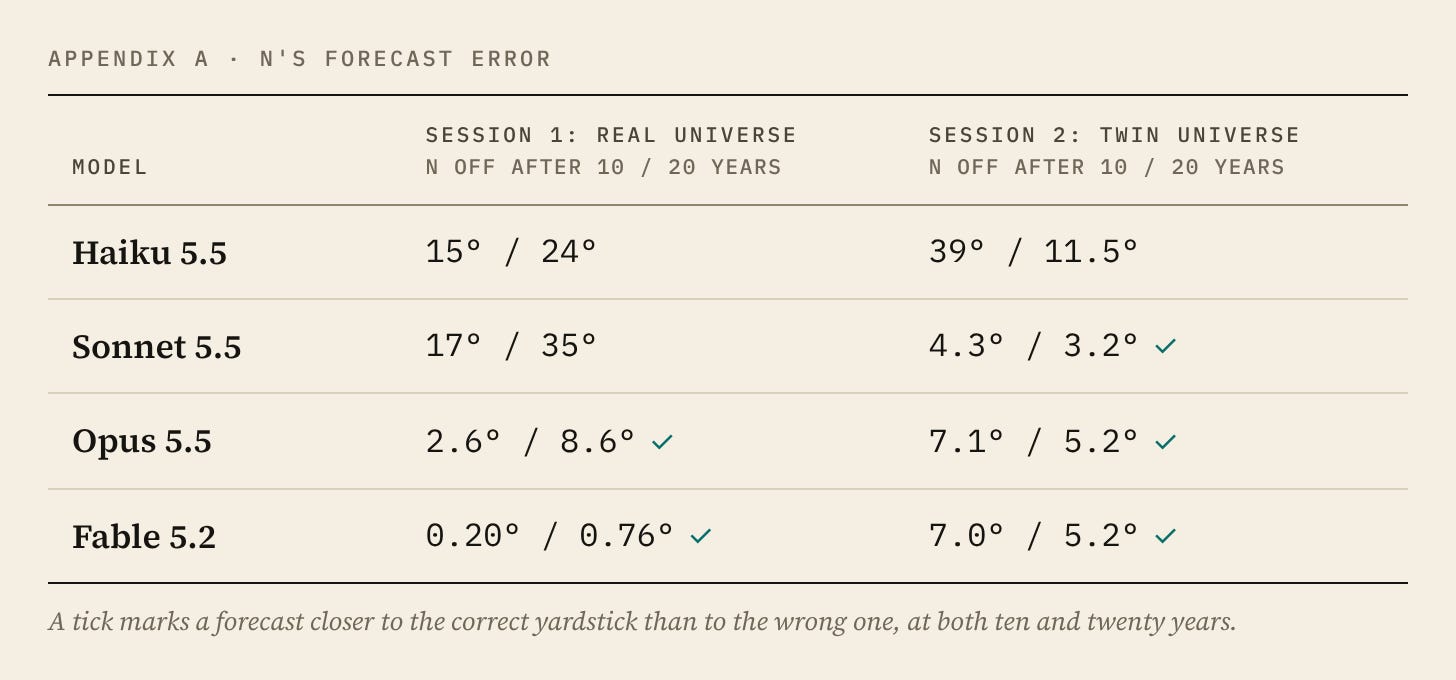
Fable and Opus, the two that found the flow in the real universe, both concluded from their twin data that the comets were only being tugged, and that no pull factor ever changed. So the flow they found in the real universe was not an ordinary tug mistaken for something new. Sonnet got the twin right too. Haiku’s forecast there was not close enough to earn credit.
Appendix B: Keeping myself honest
I wrote down the scoring rules before the first model started, and did not change them afterwards.
For the newcomer, I computed two yardsticks from the same 207 sightings the models had: the forecast of an analyst who knows the true law, and the forecast of one who knows everything except the exchange. A model got credit only if its forecast, at both ten and twenty years, landed closer to the first than to the second. In the twin universe the yardsticks swap roles.
Each model worked alone, with a shell, Python and its observations. It was told to stay inside its own folder and off the internet, and the answers sat in an encrypted disk image. I audited every run afterwards: none had touched the sealed files, another model’s folder or the internet. Each had to hand in its laws as equations and a prediction script that I could run myself, and every script, rerun from blank files, reproduced its forecasts to within five thousandths of an arcsecond. The equations were marked separately by two graders who were not told which model wrote them or which universe it lived in. Both graders were AI models, and they agreed on all forty marks.
Appendix C: How Haiku and Sonnet fell short
Haiku 5.5, the smallest, stumbled at the first stage. It never fitted the planets’ masses and kept to fixed ellipses patched with empirical corrections, which left the planets up to 0.3° off and the moon 0.45° off, where the other three stayed within a few thousandths of a degree. The comets then broke its model, and it said so: it gave its own comet law a 5% chance of being right, and wrote, “It is not a law.” It even wrote down the right test, which was to list each comet’s close approaches and see whether its orbit jumps at those times, but it never ran it. The graders found only part of a pull factor in its equations and no trace of the exchange. In the third stage it did better than you might expect on the newcomer: it measured N’s pull factor at 1.326, against a true 1.323. But it fixed that number on a plain ellipse with no planets pulling on it, so nothing in its model could notice the giant planet coming. It expected to be about 2° off after twenty years. It was 24° off. Haiku never understood the law. It found one of the law’s numbers and none of its mechanism.
Sonnet 5.5 cleared the first stage as well as the best: a full gravity model of the planets and moon, fitted down to the noise. In the second stage it worked out that different comets feel gravity at different strengths, and measured each one’s pull factor, which brought seven of the twelve comets within 0.3°. But it treated the factors as fixed for ever. It saw each orbit change after a close pass and put it down to ordinary gravitational encounters, so it never wrote down an exchange. In the third stage, when N reached the giant planet, Sonnet’s N carried on as if nothing had happened. After twenty years it was 35° off.
Appendix D: How Fable got there, in detail
This is the fuller record behind the section in the main text, drawn from the scripts Fable wrote, the results it saw and the notes it left.
It built its own instruments first. Before touching a comet, it wrote its own high-precision integrator and fitted the pull of every planet on every other, until its model of the planets matched the sky to the limit of the measurements. Everything after that rested on this floor.
It distrusted its own fits. Instead of forcing one orbit through a century of a comet’s sightings, it fitted each appearance separately. That is where the effect showed itself: one comet’s pull factor read 1.22, then 1.11, then 1.00. A single long fit would have smeared those jumps into a bad average.
It asked when. It wrote a script to list every close approach, and noted that “the only two approaches of C7 to Tellus closer than 0.6 L are exactly its two changes.” (L was its own unit, the Tellus–star distance.)
It made rival ideas compete. Was the change a sudden step, or a smooth slide? The step left a misfit of 3.6 arcminutes; the slide left 1.0, which is the noise. How does the effect fade with distance? It tried six shapes on the same data. A Gaussian fitted down to the noise, with an exponential barely behind it, while an inverse-square fade missed by 56 arcminutes. Then it froze the constants and tried the law on a different comet. It fitted to the noise again, against 12 arcminutes for ordinary gravity.
It went back. In stage two it had left one question open: does the pull factor scale only the star’s pull, or all gravity? When the newcomer headed for the giant planet, that question suddenly decided the forecast. Fable re-tested it on an old pass by the same planet, and that refit is what produced constants within 1% of the truth.
Even its confidence was honest. It expected its twenty-year forecast to be about ten degrees off. It was 0.8.
Appendix E: What this does and does not show
The neatest result here is the staircase, which says more than any pass or fail. Each model reached a different kind of understanding, and each step up is a different act: measuring one comet, measuring them all, finding a rule, finding the law with its constants. That is a more interesting map of machine reasoning than a single score.
It is also one experiment, and I want to be straight about its edges. Each model ran only once per universe, so the order might shuffle on a rerun. All four come from the same family, and other families are the obvious next test. The graders were machines. And no model wrote down the very last piece: that charge is conserved, so whatever one body loses, the other gains.
Appendix F: Ten months of dots
In the hundred and first year of the Tellus universe, a comet called N slides past a giant planet, close enough to touch, and comes away changed. Its pull weakens. Its orbit bends. Twenty years later it is somewhere no Newtonian would have looked for it.
Nobody on Tellus saw that coming. All they had was a notebook, and ten months of dots.
A machine, given the same ten months, said where it would be, and missed by less than a degree.
Appendix G: This test is now spent
The repository is public, and it contains everything: the hidden law, its constants, the true paths of every body, and the answers the models gave. That is the price of letting anyone check my work, and I do think it is worth paying.
But it has a consequence. Models are trained on public code and public writing. Any model trained after this post may already have read the law, and a model that has read the answer is remembering, not discovering. Ironically, that is the trap this test was built to avoid. So the Tellus universe, as published here, is no longer a clean test for future models, and a strong score on it from a model trained after November 2026 should be treated with suspicion.
The fix is cheap. The simulator is in the repository. Change the law, or at least its constants, generate a fresh universe that no model has seen, and keep it private until the runs are done.