


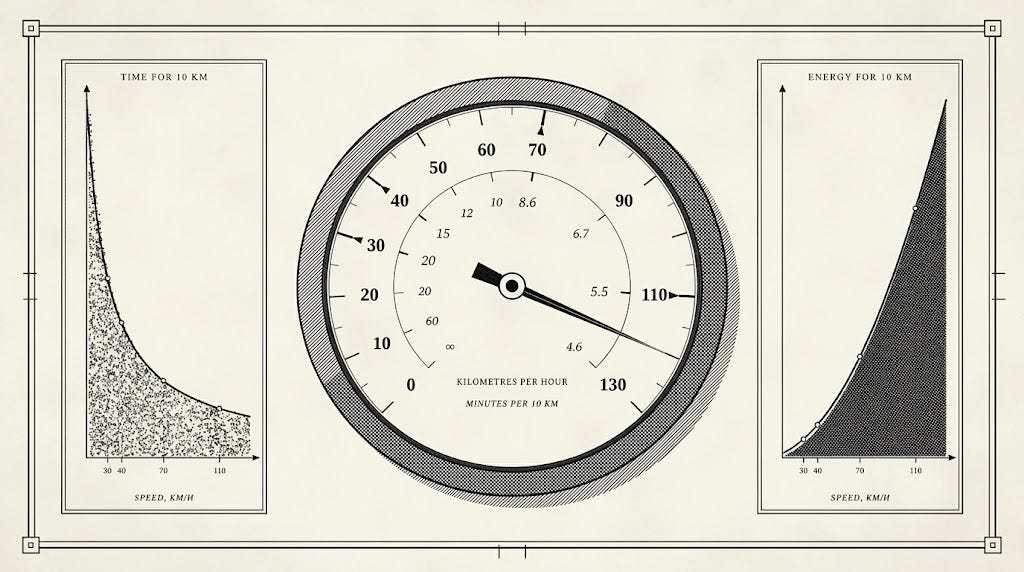
It is dusk on the A2, somewhere between the Belgian border and Eindhoven. And I am doing the thing every driver does without quite admitting it: nudging the accelerator a fraction further than necessary, watching the needle climb past 120. There is a car ahead, slower, and the small triumph of passing it feels disproportionate to the manoeuvre itself. Somewhere in the older part of the brain, a calculation is running. Faster equals sooner. It feels obvious. It feels like arithmetic. It is arithmetic. Just not the kind that part of the brain thinks it is doing. This article, which was left in my drawer over the summer, is about the shape of that curve.
The Shape of the Curve
Travel time has one of the oldest formulas in physics: time equals distance divided by speed. Obvious, right? However, what almost nobody internalises, is that this relationship between speed and the time it takes to cover a given distance is not a straight line.
It is a curve. And a particular kind of curve; one that falls steeply at first and then flattens, buying you less and less time for each additional unit of speed, all the way out towards infinity without ever quite reaching zero.
Let’s run the numbers on a hundred-kilometre journey. Increase your average speed from 30 km/h to 40 km/h, and the trip time falls from 200 minutes to 150. You have saved 50 minutes for an increase of 10 kilometres an hour. Now increase your average speed from 70 km/h to 110 km/h, a jump four times as large. The trip falls from roughly 86 minutes to 55. You have saved barely 31 minutes, for a far bigger push on the accelerator.
Each extra kilometre an hour buys you less time than the one before it, no matter how hard you press.
What the curve proposes is that the benefit of going faster depends not on how much faster you go, but on how fast you already were when you started. Push from a crawl and you reclaim huge handfuls of time. Since time is distance divided by speed, this means we are dividing distance by a tiny speed number to begin with. Push from a speed that is already brisk, and you are dividing by a number that barely moves the result. The same ten kilometres an hour means something completely different depending on where on the curve you happen to be standing.
This felt really strange to me. When you sit with it, you notice that this is a strange thing for a universe to insist on. Most of engineering is built on the comforting idea that more input gives you more output, even if the ratio of input/output degrades a little.
In this case, however, the degradation is not gentle. By the time you are already moving quickly, additional speed has nearly no impact. The curve has done nearly all the work it is ever going to do, in the slow parts that you have already passed through. What nature is telling you is that going faster, isn’t going to get you home very much faster than before.
The mismatch between this curve and what people expect of it has a name. In 1970, the Swedish psychologist Ola Svenson documented what is now called the “time-saving bias”: asked to compare a speed increase from 30 to 40 km/h against one from 70 to 110 km/h, most people pick the second, larger-looking jump, when the first actually saves nearly 20 more minutes on a 100 km trip. The bias even survives contact with expertise. When researchers later interviewed taxi drivers mid-journey, professionals who spend entire careers converting speed into arrival time, the drivers misjudged the trade-off almost as badly as everyone else.
Even drivers who price their entire livelihood on arrival time still misjudge the curve.
What It Costs to Buy Back a Minute
There is a second curve running beneath the first, and this one makes you question why anyone even tries to go fast.
Push a car through the air and the air pushes back with a force that grows with the square of your speed. Take it from 80 km/h to 100, a quarter faster, and it resists roughly 56 per cent harder, the resistance running ahead of the speed that caused it. The power needed to overcome that resistance, force multiplied by velocity, climbs faster still: the cube of your speed. Multiply the cube by that shrinking duration of your trip, and one power of speed cancels itself out. This is the same shape as the first curve, but running the other way. Where that one pays out less time for every extra kilometre an hour, this one charges more energy for every one of those same kilometres. At the low-speed end, a little more energy buys back a great deal of time. At the high-speed end, a great deal more energy buys back almost none.
There is a clean way to state how brutal the trade becomes. Because energy spent against drag grows with the square of speed, while time falls with the simple reciprocal of speed, halving your journey time over a fixed distance does not double the energy bill. It quadruples it. The cost of buying back a minute climbs sharply, scaling with the cube of the speed you are already carrying.
When the Curve Still Has Room to Fall
Don’t be despondent though. This doesn’t mean that speed is entirely pointless. It only means that speed only pays where the curve still has somewhere to go, and the thing that decides whether it does is not the speed itself. It is the speed that you start with, but more importantly it is the distance over which that speed gets to act.
Consider Concorde. Cruising at Mach 2.04, around 2,180 kilometres an hour, it travelled at well over double the speed of the subsonic jets that replaced it, and it paid for that speed exactly as the second curve predicts: roughly five times the fuel per passenger of a modern long-haul jet, the drag of supersonic flight devouring fuel at a rate no airline ever made financially comfortable. On a short hop, that bill would have bought almost nothing back, eaten up by taxiing, climbing, and the simple fact that there is not enough distance for a curve to bend over. But London to New York is the better part of 5,600 kilometres, and over that distance the same proportional speed increase that buys almost nothing on a daily commute became something extraordinary: a crossing of a little under 3.5 hours, against roughly 8 for a conventional airliner. Concorde did not defeat either curve. However, it found a distance long enough that the time curve still had room to fall, even after paying the energy curve’s full price.
That is also, quietly, why nobody ever built a supersonic commuter train, or a Mach 2 taxi. The same arithmetic that made Concorde a marvel over the Atlantic would make it pointless over a few kilometres of city traffic. The curve does not care how impressive your top speed is. It only cares how much distance remains for that speed to spend itself on.
Speed pays its dividend in proportion to how much distance is left for the curve to fall across.
What the Needle Knows
Back on the A2, the car I overtook has long since vanished into the mirror, and the satisfaction has already faded faster than the manoeuvre took. I do the sum in my head, more out of habit now than curiosity: at this speed, on this stretch of road, the difference between pressing on and easing back amounts to perhaps ninety seconds over the whole drive home. Ninety seconds, against a small, persistent appetite for risk that the dashboard barely measures and the body cannot help but feel.
I ease off anyway, less out of virtue than because the arithmetic has finally caught up with the instinct. The needle drops back towards 120km/h, settles, and stays there. Outside, the road keeps unspooling at almost exactly the same rate it would have a moment before. The curve, indifferent to any of this, goes on doing what it has always done: paying out fast at the start of every journey, and almost nothing at all near the end. The wallet though, always pays the price.
Very enjoyable piece that I’d specially recommend to highway tailgaters! The disproportionality of the the tiny and costly gain versus the safety risk to them and the driver in front 🤦🏽