


Every tool that makes thinking faster does so by hiding something.
A calculator hides arithmetic. A map hides geography. A search engine hides the library. These hidings are exactly the point of the tool. You did not come for the friction. You came for the answer.
AI assistants are the most powerful hiding mechanism ever built. Ask a large language model why full-flow staged combustion took fifty years to reach flight, or how viral replication actually works, and it will hand you a complete, fluent answer in seconds - the shape of understanding, perfectly formed, delivered to you without the hard work that once forged it.
Sometimes that shape is enough.
Sometimes it is not.
I discovered the difference in a shower.
The shower
In preparation for my upcoming essay, I spent an evening with NotebookLM walking me through the constraints of full-flow staged combustion. Flashcards, podcasts, structured summaries - it explained the oxidiser-rich preburner, the turbopump balance, the thermodynamic elegance of the cycle. By the end I felt I understood why it had been so difficult, and why SpaceX had succeeded where others had failed. I closed the laptop satisfied.
Then I stepped into the shower, and the understanding began to dissolve.
Not all at once. First the edges softened. I tried to hold the chain of reasoning - why the oxidiser-rich environment created the corrosion problem, why that corrosion problem had kept the ceiling out of reach for fifty years - and found I could gesture at it but not reconstruct it. The pieces were there, but they had no weight. They had arrived as conclusions, not as things I had worked out. Without the work, there was nothing to hold them in place.
By the time I stepped out, dripping on the bathmat, I had the vocabulary but not the understanding. And the two turned out not to be the same at all.
That quiet vertigo - arriving at the destination without having walked the path - is the soul of what is happening to us. Not spectacular failure. Not catastrophe. Just a slow, barely perceptible thinning of the ground beneath our thinking.
That quiet vertigo - arriving at the destination without having walked the path - is the soul of what is happening to us.
What happened in that shower was not unique to research, or to rocketry, or even to me. It has a structure. You reach for a tool that operates one level above the work itself. The tool returns something clean, complete, and correct. And what disappears - quietly, invisibly, with no error message - is the ground that would have let you stand on your own when the clean answer is not available. The mental structure you never had to build. The instinct you never had to develop.
That same structure repeats everywhere the new tools are being used: in software, where AI writes the code; in strategy, where it summarises the landscape; in writing, where it generates drafts.
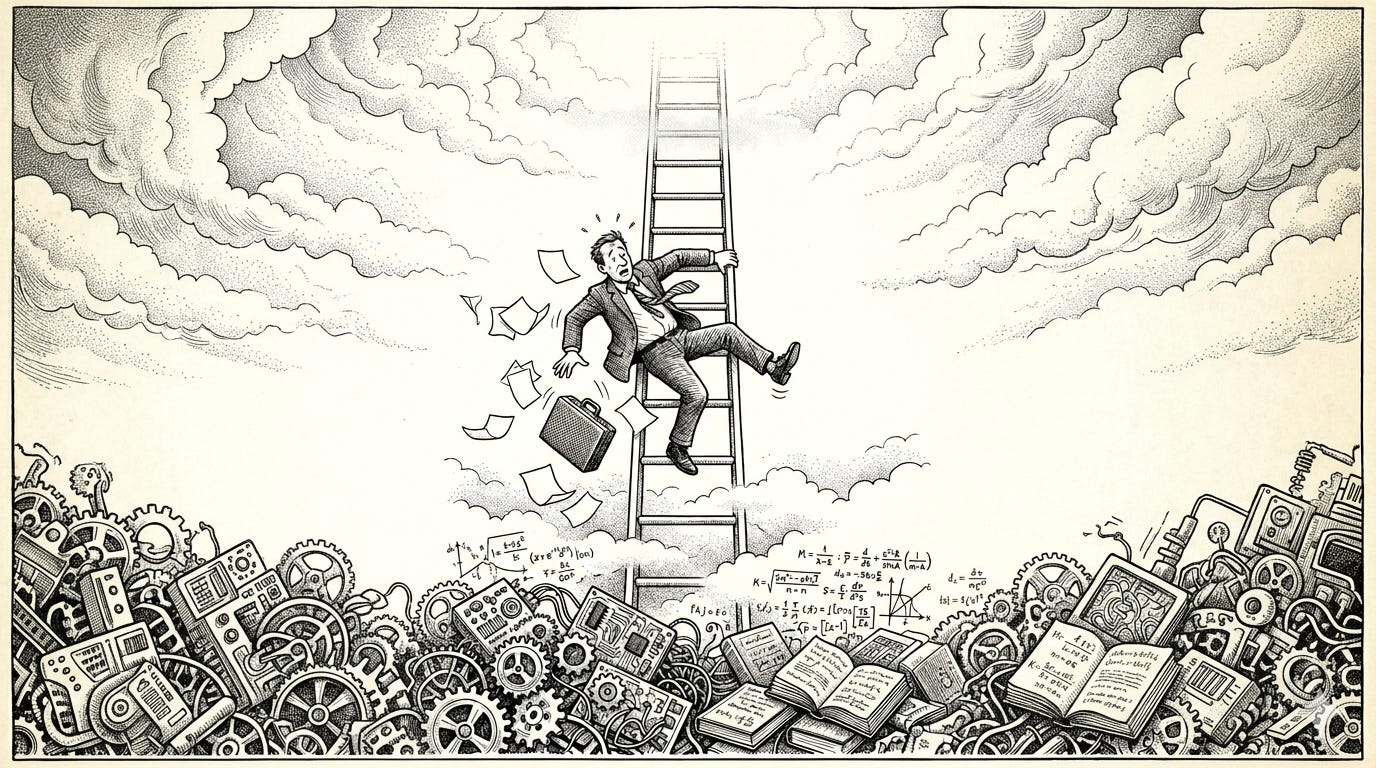
The ladder
Software development has been doing this for seventy years. Each generation of tools has hidden something the previous generation had to think about directly - and in hiding it, has made it unthinkable.
In the 1950s, there was no such thing as “sort this list.” There were only instructions - individual operations addressed directly to the machine. When C replaced assembly, register allocation did not become easier. It vanished from the programmer’s mind entirely. When Python replaced C, memory management disappeared the same way. A programmer who has only ever written Python does not merely lack the habit of tracking memory. They lack the instinct. Recovering it requires deliberate, almost archaeological effort - like trying to see the individual pixels in an image you have only ever encountered as a photograph. Each rung did not just simplify the work. It quietly narrowed the mind doing it.
This is what abstraction actually does. It does not simplify the level below - it removes your ability to think about it at all. What disappears from thought does not disappear from reality. The machine is still working. You simply no longer see it, and more strangely, you no longer miss it.
Until you do.
What disappears from thought does not disappear from reality. The machine is still working. You simply no longer see it, and more strangely, you no longer miss it.
The same structure runs through every domain where AI is now doing the cognitive heavy lifting. A market strategist who uses AI to generate competitive analysis operates at a level where the messy reality of the market has been summarised away. A researcher who asks AI to synthesise a field receives a clean narrative where uncertainty, disagreement, and unresolved questions have been quietly resolved.
In each case the tool is not necessarily wrong. The output would be accurate. What is missing is the work of having had to think it through - the resistance that builds the mental structure you can stand on when the clean answer runs out.
AI-assisted coding is only the latest rung on this ladder, and it has the same property. You describe what you want and the implementation appears. What has been handed off is the crucial logic of the specific thing you are building. Something that has never existed before, whose failure modes are unknown, and which will need to be understood the day something goes wrong.
The shower moment, scaled to engineering. The same reaching. The same smooth space where the understanding should have been.
The cost
Peter Steinberger built OpenClaw - the open-source AI agent that became the fastest-growing repository in GitHub history - almost entirely alone, in three months. He does not read most of the code his agents produce. He skips the boilerplate, the routing, the plumbing. But he reads everything that touches the database. Everything where a wrong decision would be invisible in normal operation and catastrophic when discovered.
What he has worked out is an empirical theory of where the line is - and at which level humans should operate. You can go high on code whose failure modes are visible and whose logic is not novel. You cannot go high on code whose failure is silent or whose logic encodes a decision someone will later need to understand and defend. That code needs an author. Someone who made choices, knows what they were, and can say why that thing exists. Someone who, standing in a shower with no screen in front of them, could still reconstruct the reasoning.
The real cost is not bugs. Bugs are normal. The real cost is authorship - the intellectual intimacy with your own creation that lets you stand behind it when it fails.
The ceiling
The ladder keeps growing. The right level for a given problem today is not the right level in two years. What feels cutting-edge becomes infrastructure - invisible, assumed, built upon without a second thought by people who will never need to know what they are standing on.
This is how it has always worked. What is different now is the pace. The ground beneath our thinking is rising faster than it has ever risen, which means the things we can no longer see are accumulating faster than any previous generation had to account for.
Some of the new abstractions will prove wrong. Others will become load-bearing. Knowing which is which, before the market has rendered its verdict, is not a skill any tool can give you. It comes from understanding the ladder - not just where to stand on it, but why the rungs are arranged as they are, and what disappears from view each time you climb.
The ground
Think about what happens when you open a new conversation with an AI assistant. A cursor blinks. You type. An answer arrives.
Underneath that cursor lies seventy years of accumulated abstraction - every language, every compiler, every protocol - built by people whose names you will never know. All of it invisible. All of it working. All of it holding you up.
The Soviet rocket engineer Glushko understood the thermodynamic argument for full-flow staged combustion in 1967. The physics was clear. The ceiling was visible. Yet it took fifty years for the floor to rise and meet it. The answer was knowable. What was missing was the long, costly friction of turning knowing into building.
The answer was knowable. What was missing was the long, costly friction of turning knowing into building.
The new tools remove most of that friction. That is why they are astonishing.
And that is why the small portion they cannot remove - the resistance that turns borrowed knowledge into something you can truly own - has never mattered more.
In the shower, with no screen in front of you, reaching for something that should be there and finding only smooth space - that is where the real question lives. Not in what the tools gave you.
In what remained when they went dark.
Fantastic reflection Arvind! And uplifting! The friction, which I like to see as “distilled chaos”, is very precious indeed! Let’s make sure we spend more time in it!
Dude! Great stuff!
I write something somewhat similar on the topic a few days ago, albeit from a completely different angle!
Check it out when you’ve got the time!