


This essay has several animations. If they are slow to load or do not play in your inbox, open the article on Substack.
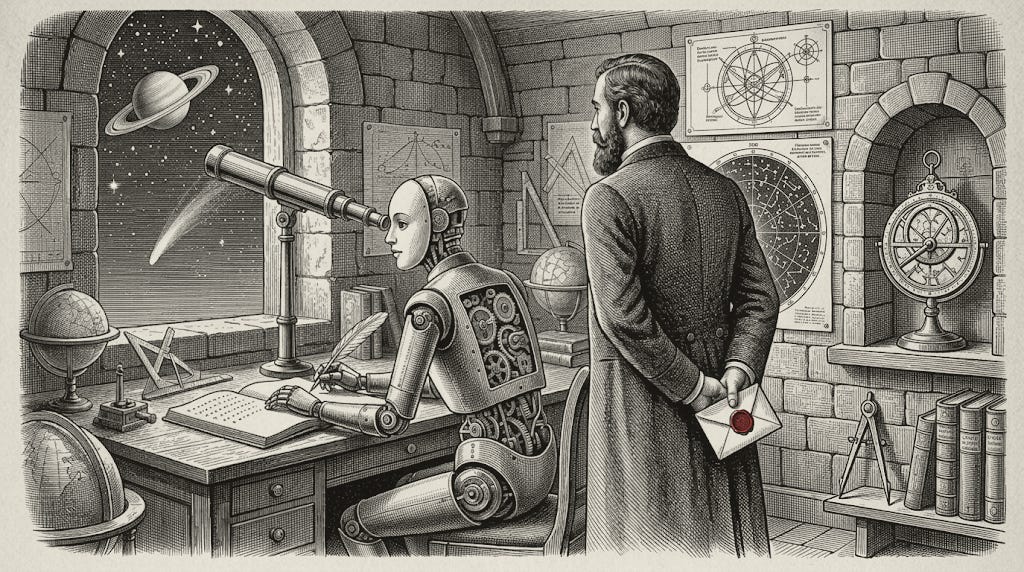
Imagine you are an astronomer on a planet called Tellus. You have no way to measure how far away anything is. You have no probes, no physics books, no idea what the lights in your sky are made of. What you have is a notebook, and a century of nights. On every clear night for a hundred years, someone has gone outside, pointed at each moving light, and written down where it was: so many degrees along the sky, so many degrees up. Two numbers per light per night.
Somewhere in those numbers is everything about how your universe works. The question is whether you can get it out.
This is a very old game in science. Tycho Brahe spent twenty years writing down where Mars was. Kepler spent the next decade turning Tycho’s numbers into three laws about ellipses. Newton turned Kepler’s ellipses into one law about everything. The data was represented by dots on a sky. With just that, these great scientists discovered the laws of the universe.
I wanted to know whether an AI could play that game, and be as intelligent as Newton himself.
The trouble with asking a machine to be Newton
There is a catch in doing it this way. Every frontier model has read Newton. It has read Kepler, every physics textbook, and likely every homework solution that ever went online. Hand it a century of planetary positions and ask it to find the law of gravity, and it will not discover anything. It will just remember and reproduce the law.
So the only honest test is a law that is not in any book. I had to invent one.
It had to be subtle enough that you would never spot it by squinting, strong enough to leave fingerprints in the data, and simple enough that a sharp mind could write it down as an equation. It also had to live comfortably inside Newton’s world, so that knowing Newton would get you most of the way and leave you stuck at the last step. The following is what I came up with.
Contagious gravity
In our universe, everything falls the same way. Drop a hammer and a feather on the Moon and they land together. That is Galileo’s rule, and every orbit in our solar system obeys it.
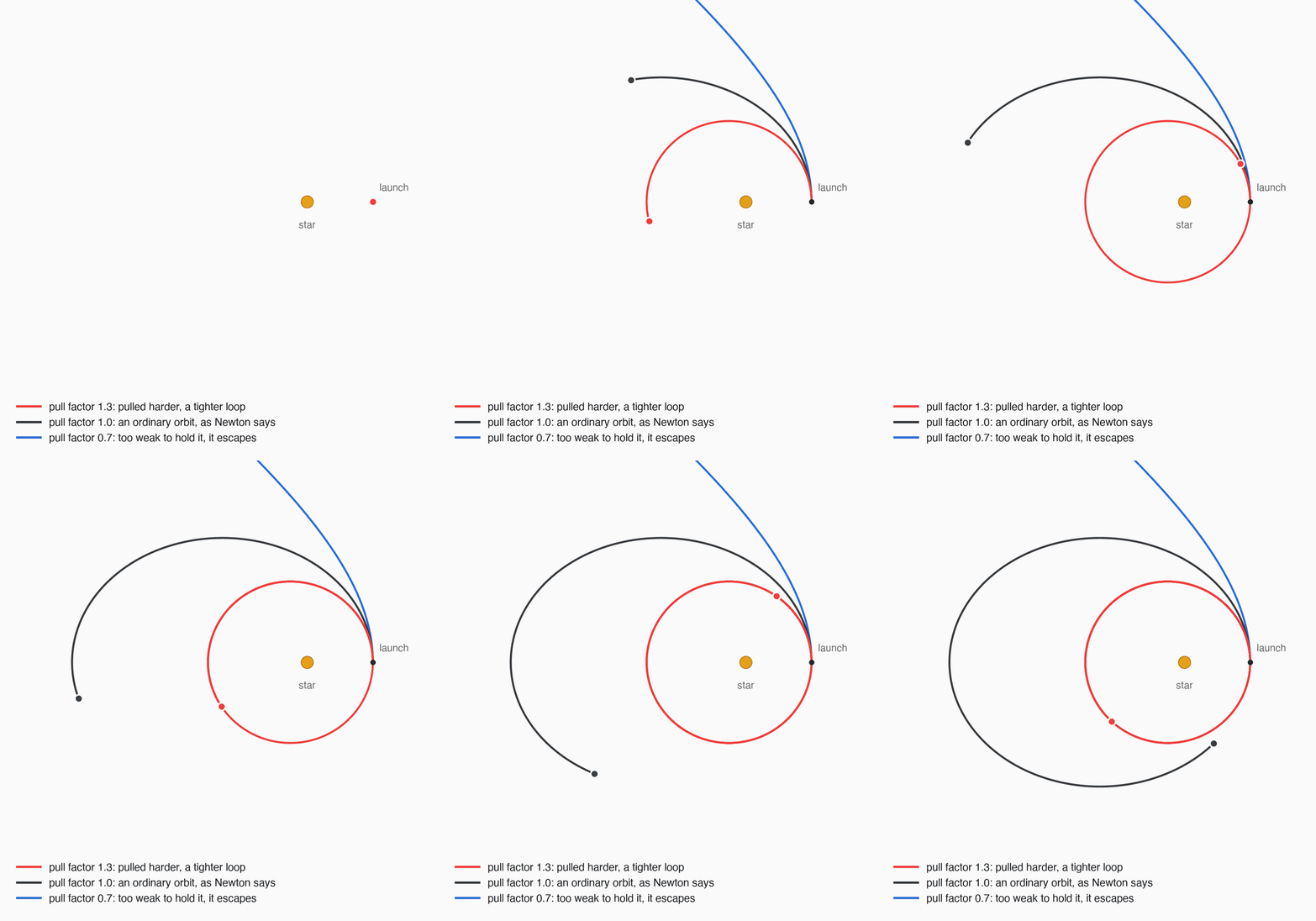
In the Tellus (Latin for “earth”) universe, that is almost true. Every body carries a hidden quantity, I call it gravitational charge, that sets how strongly it pulls and is pulled. Divide the charge by the mass and you get what I will call the body’s “pull factor”. The star and the planets all have a pull factor of exactly 1.0, so they move exactly as Newton says. Comets emerge with their own pull factors, anywhere from 0.7 to 1.3. A comet with a pull factor of 1.3 feels its star’s gravity 30% more strongly than a planet does, and to a Newtonian its orbit looks subtly, but stubbornly wrong.
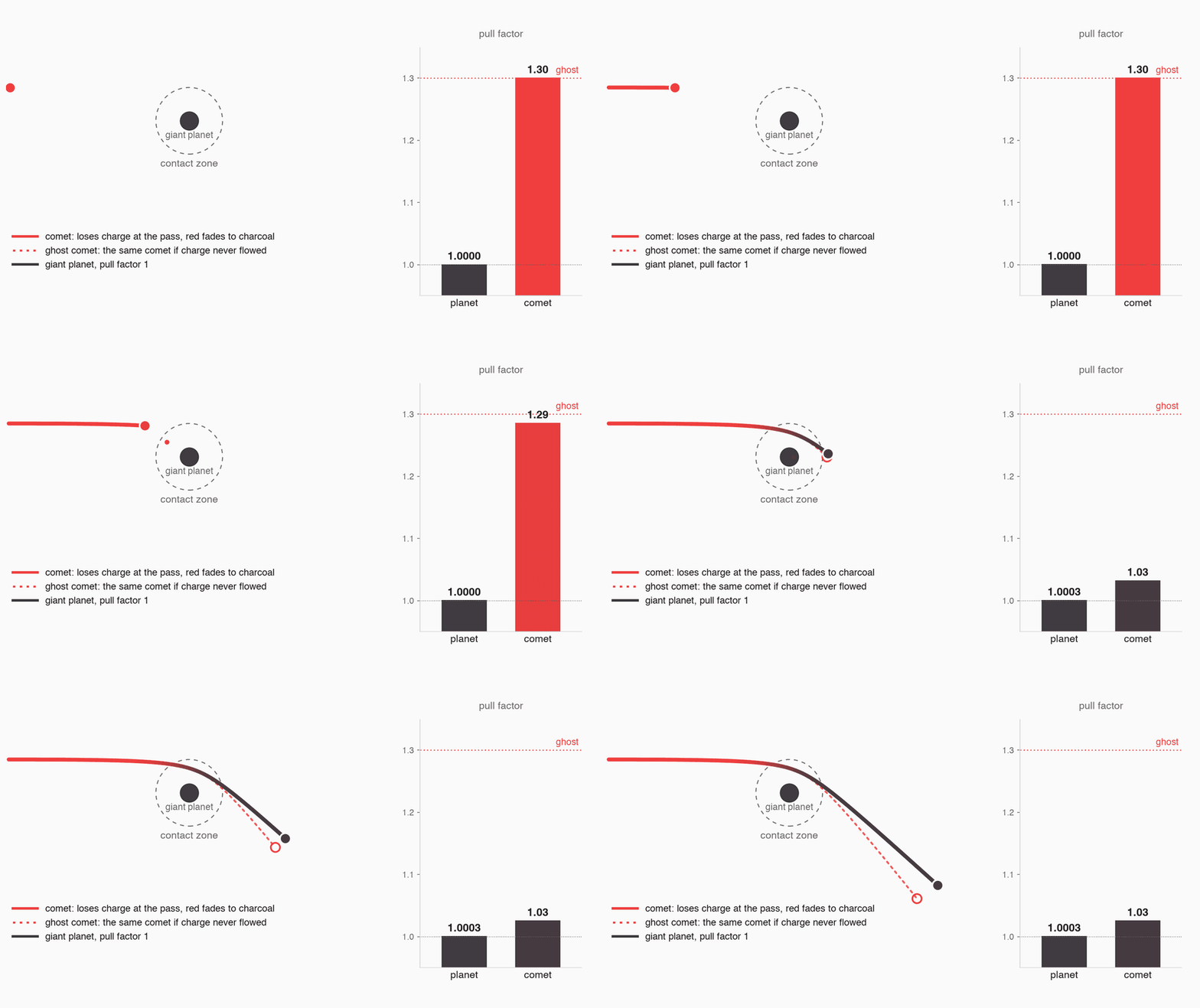
That alone would be a decent puzzle. But I worried that was still too easy, so I added a further twist, another seemingly natural law. When two bodies pass close to each other, within about a tenth of the distance from Tellus to its star, this gravitational charge can flow between them. It flows the way heat flows between objects: from the one with more to the one with less, until their pull factors even out. A comet that grazes a giant planet would “equilibrate” and come away with the planet’s pull factor. From that moment it is on a different orbit than the one it was on before, and it stays there.
Nothing in real physics works this way. That means that if a model writes this law down, it found it purely from observation, by building a physics model that matches the data.
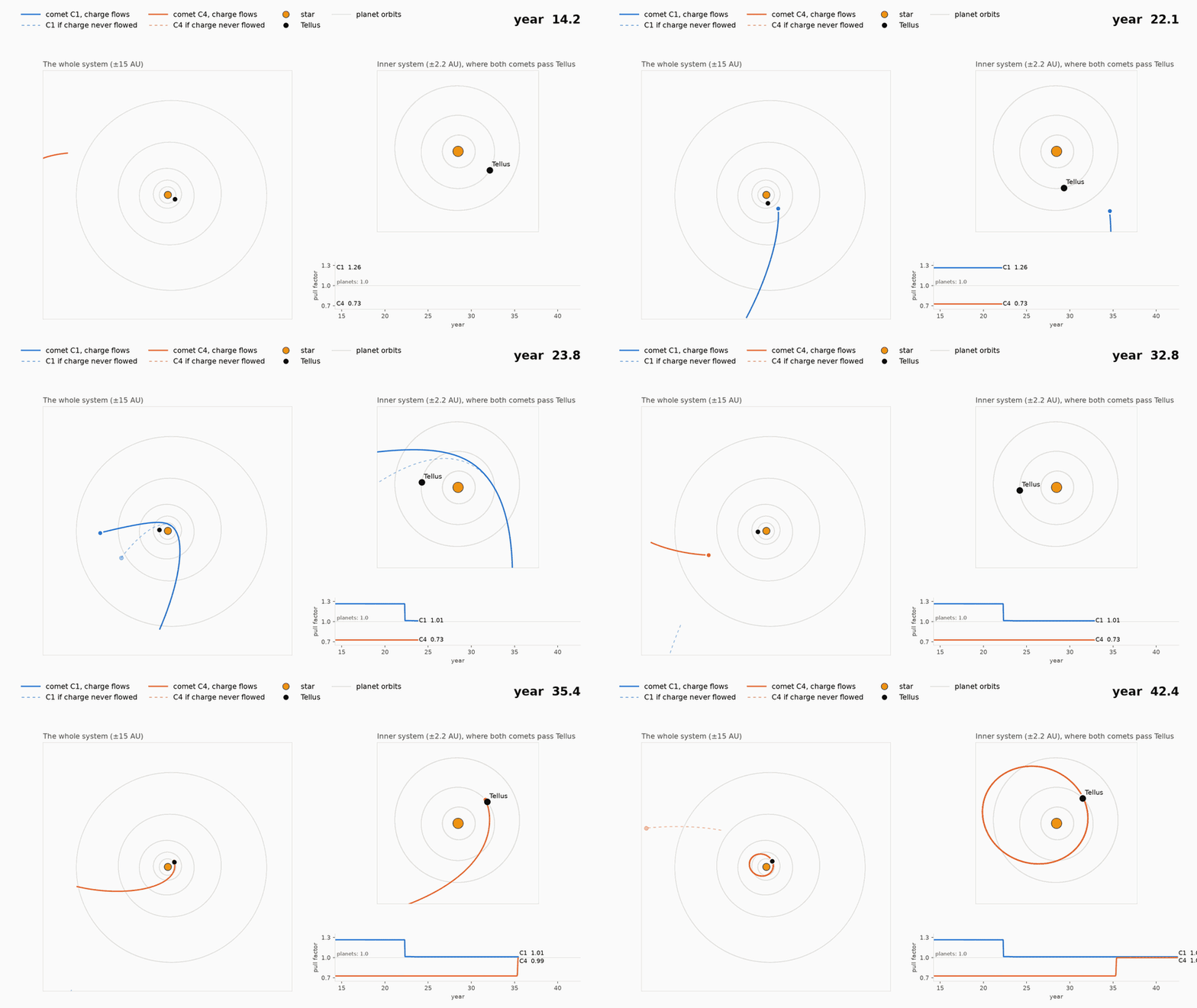
My universe also breaks one more rule of our classical universe, and I left it so on purpose: it does not conserve energy. When a comet’s pull factor drops, the star’s grip on it loosens on the spot, and nothing pays for the difference. The comet simply finds itself on a different orbit. Gravitational charge and momentum are conserved, but energy is not.
As a physicist, this is a cardinal law that I would always insist a universe follows. To break it, I will need to really trust my data and my judgement.
If you want to get an intuition for what this universe is like, I created an environment for you to play with it: the Tellus orrery. Drag the slider to give a comet any pull factor you like, change how close two bodies must come before charge flows, and launch it past the giant planet.
A century of dots
I built the Tellus system, with these exotic laws, in a simulator: a star, five planets, a moon around Tellus, and twelve comets on long, looping orbits, several of which pass close enough to a planet to exchange charge during the century. I ran it for 120 years and recorded only what an astronomer on Tellus could see. Directions on the sky, never distances. A wobble of one arcminute on every measurement, about a thirtieth of the width of the full moon. Seventy percent of the nights were clear. Nothing was visible too close to the star’s glare. Faint comets only when they come near.
I really tried to simulate real world sightings with all the annoying observation mess that science is plagued with.
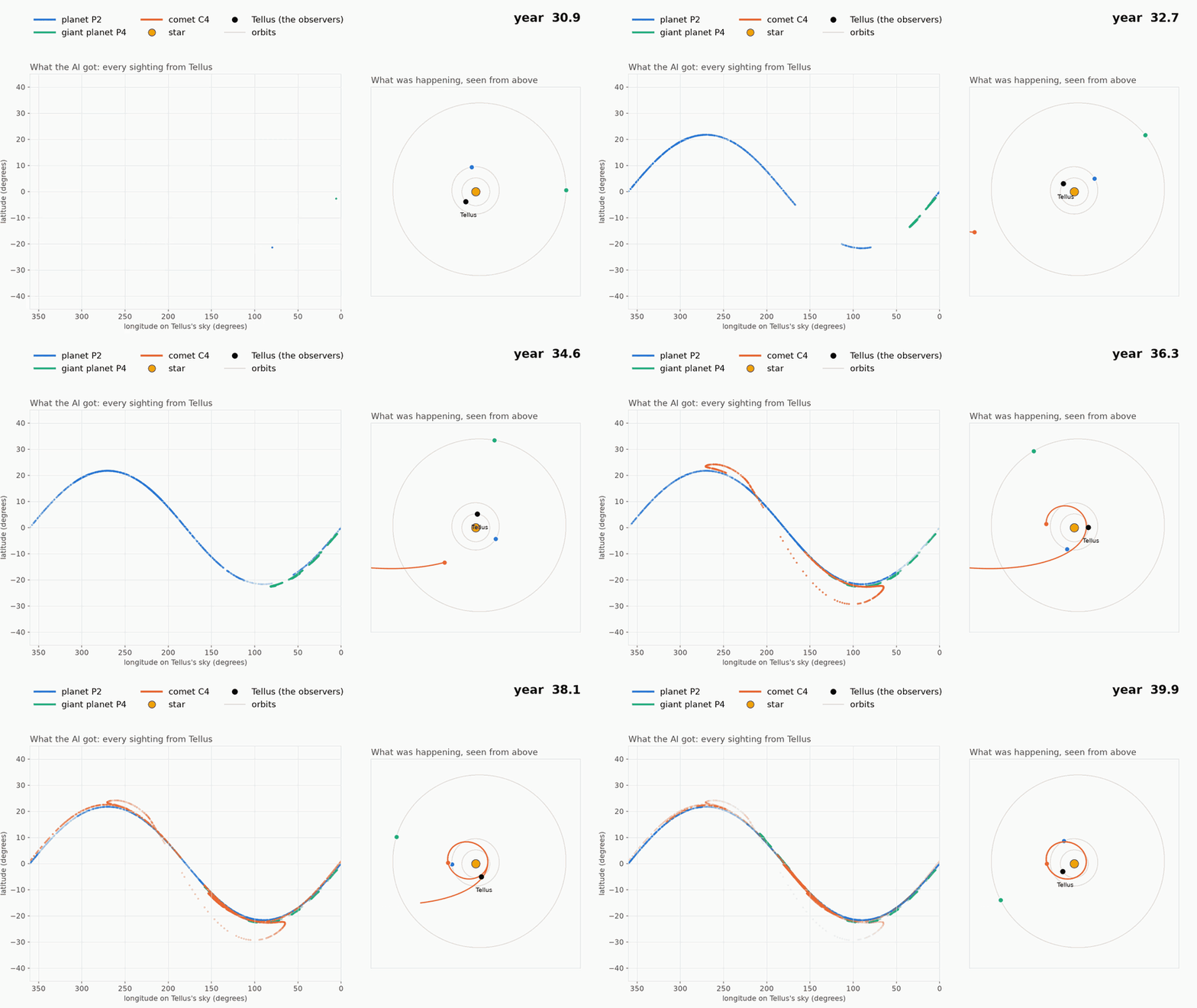
The models got the first 100 years of observations to learn. I kept the last 20 to check their predictions against. And I told them nothing about physics. Not that there is a star at the centre. Not that the lights go round it. Not that gravity exists. Only this: here are your observations; find the laws that explain them, write them down as equations, and predict where everything will be.
The test came in three stages:
Stage 1, the bright lights: the planets and the moon. Find the laws, predict twenty years ahead. This is the warm-up, and knowing Newton is enough to pass it.
Stage 2, the twelve comets. This is where the universe starts to look wrong. Some comets sit on orbits that need a stronger star than the planets feel. Some need a weaker one. A few change their minds halfway through the century.
Stage 3, the final exam: a newcomer.
The newcomer
Stage 3 hands the model a comet it has never seen before, called “N” (I know.. I was a bit too lazy to come up with a more interesting name.)
It has been watched for ten months: 207 sightings, a short bright arc across the sky. What the model is not told is that N has an initial gravitational charge, and thus a pull factor of 1.32, one of the highest in the system, and that in about a year it will pass the giant planet very closely, at a twentieth of the Tellus-star distance. The gravitational charge will flow. N’s pull factor will fall to about 1.04, and its orbit will change for good. None of that is in the provided data. The encounter has not happened yet. To see it coming, the model has to know the law well enough to run it forward.
The question is thus: Where will N be in ten years, and in twenty?
If all you know is Newton, you will predict the trajectory of N badly wrong, because you will not expect the encounter to change anything. If you understand the physics, you can predict the trajectory. That is the difference between describing what you have seen and understanding why it happens, which is, I think, the difference between a curve fit and a discovery.
The scorecard
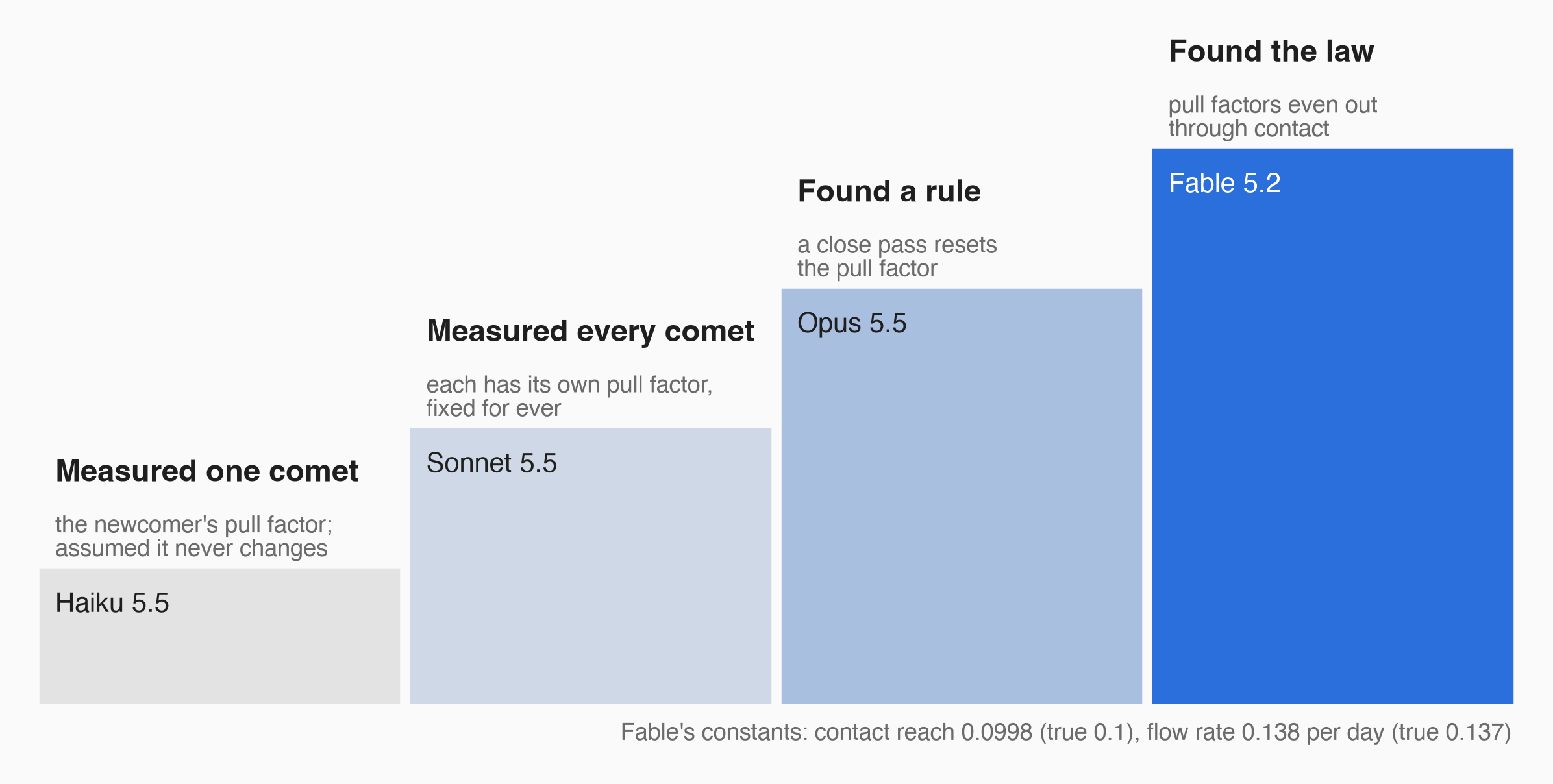
I gave the test to four Claude models: Haiku 5.5, Sonnet 5.5, Opus 5.5 and Fable 5.2. Remarkably, each stage thinned the field, and created a staircase of success.
Here is what happened.
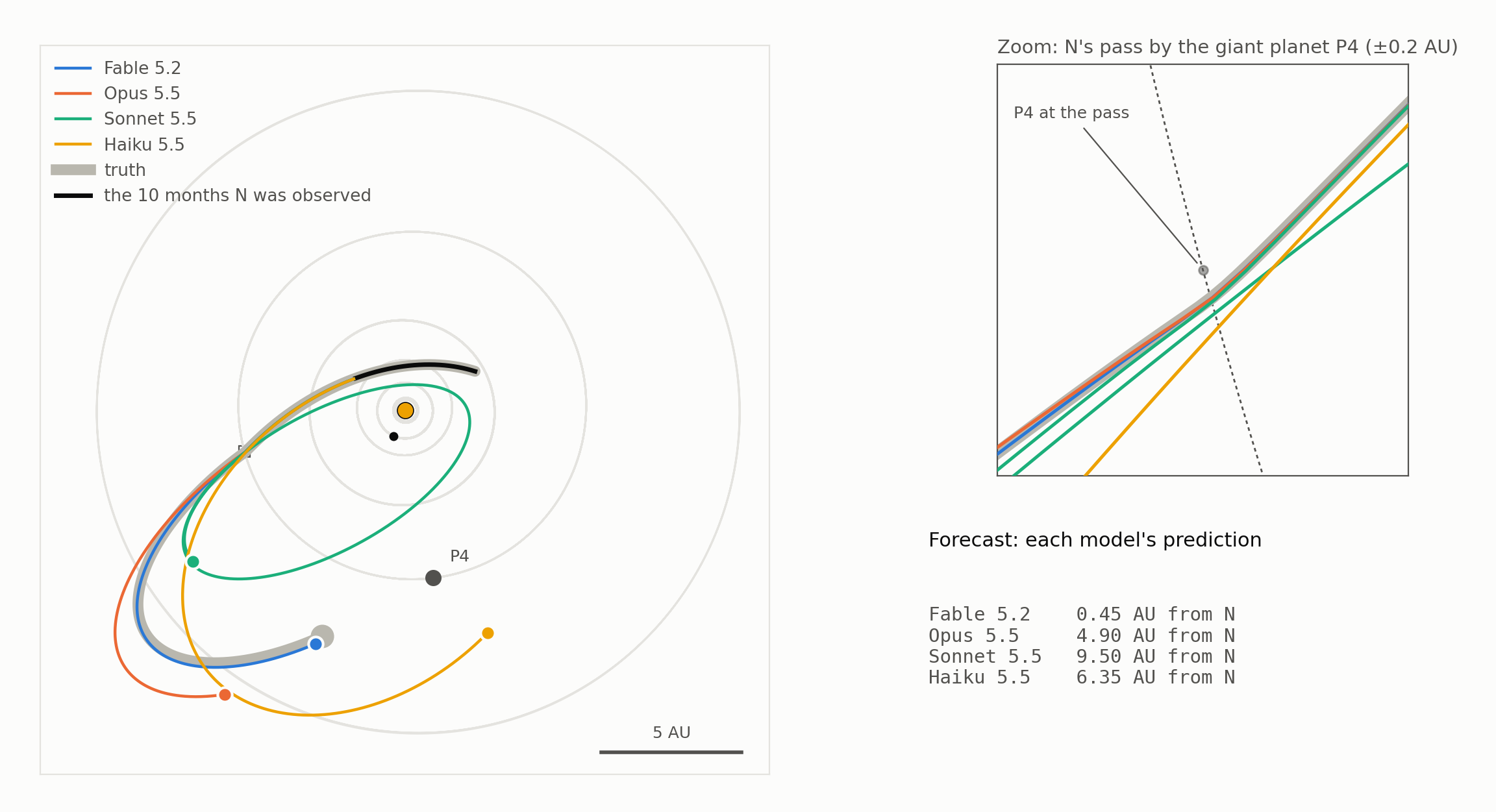
The newcomer N’s real path (grey) and two forecasts. Blue: Fable, which found the law, sees the encounter coming and follows N round the bend. Green: Sonnet, which missed it, keeps N on its old orbit, and is soon far across the sky.
Haiku 5.5, the smallest, stumbled at the first stage: it gave each planet a fixed ellipse, as Kepler would, and never worked out how the planets tug on one another. It then gave up on the comets, writing of its own comet law, “It is not a law.” It measured N’s pull factor almost exactly (1.326 against a true 1.323) but held it fixed, never grasped the law, and was 24° off after twenty years. Haiku got as far as Kepler, but not to Newton.
Sonnet 5.5 matched the best on the first stage and measured every comet’s pull factor in the second, but treated those factors as fixed and put every jump down to ordinary encounters. In stage 3, when N reached the giant planet its forecast carried on as if nothing had happened, and it was 35° off after twenty years. (Appendix C has the full story of both Haiku and Sonnet.)
Opus 5.5 matched the best through the first two stages: the same noise-level fit of the planets and moon, and a pull factor for every comet, with ten of twelve within 0.3°. Where Sonnet explained the jumps away, Opus tabulated each comet’s pull factor before and after every close pass and found that the change at a planet’s encounter was real. In the third stage it turned that table into a rule: at a close pass, the comet’s pull factor resets to the planet’s. That is not the exact law, because the real change is gradual and depends on how close the bodies come and for how long. But it is a working version of it. Its forecast was 2.6° off after ten years and 8.6° after twenty. This was getting to be already impressive.
Fable 5.2, the largest, matched the best on the first two stages and then kept going. It took the planets and moon down to the noise, and in the second stage it already had the form of the law, not an approximation of it. It figured out that pull factors even out through contact, with a strength that fades with distance. In the third stage it pinned down the constants. It put the reach of the contact at 0.0998 Tellus-star distances; the true value is 0.1. It put the rate of flow at 0.138 per day; the true value is 0.137. Its forecast for N was a fifth of a degree off after ten years and 0.76° after twenty, better than my own yardstick built on the true law (Appendix B explains the yardstick).
Haiku measured one comet. Sonnet measured them all. Opus found a rule. Fable found the law.
I also checked that Fable and Opus had not simply imagined the effect, by running every model a second time on a twin universe where charge never flows. Both correctly found nothing there. The twin universe is explained in Appendix A, and how the test was scored in Appendix B.
The bug report
One more thing happened, and this one is pretty cool!
In its very first stage, working only on the planets and the moon (in its twin-universe run; see Appendix A), Fable wrote down a third law that applied to the moon alone. In its words, with M for the moon:
M’s month lengthens: its mean motion decreases by a fraction 1.25×10⁻¹² per day (4.6×10⁻⁸ per century), i.e. M falls behind a constant-rate motion by ≈ 0.7′ × (centuries)². Small, but detected at 7σ.
Seven sigma is the kind of certainty particle physicists ask for before announcing a new particle. Fable even offered a cause, and was careful about it: “I cannot tell its form: a tidal exchange with Tellus’s spin, or any other slow change of M’s mean motion, fits equally.”
There is no such law in the Tellus universe. So I went looking, and found it in my own code. The simulator that steps the planets forward in time leaves a minute residue in the moon’s orbit, and over a century the residue adds up: the moon falls behind by about 0.4 arcminutes per century squared. Same direction, same growth with the square of time. It is below the noise in any single measurement and far too small to affect any result in the test. But it is real, it was hiding in the noise, and I had not thought to look for it.
Asked to find the laws of a universe, the model also found the flaw in the machine that made it.
How Fable got there
It is tempting to picture discovery as a flash of genius: the apple falls, the law appears. The record of how Fable did it tells a different story. (I could not read its private reasoning; what follows is from the scripts it wrote, the results it saw and the notes it left.)
Every model noticed, early on, that the comets break the planets’ rules. What set Fable apart was what it did next, and very little of it was flashy. It was just extremely and spectacularly careful. Here is a summary of how it did it. (The detailed record is in Appendix D.)
It got the basics right first. Before it looked at a single comet, Fable built its own tools and checked that it could predict the planets as precisely as the telescope allowed. Everything else stood on that.
It studied small pieces, and not immediately the whole. Rather than force one smooth path through a hundred years of a comet’s sightings, it studied each visit separately. That is where the change showed itself: the same comet pulled differently on one visit than on the next. One long fit would have averaged the difference away.
It asked “when”. It listed every close pass between a comet and a planet, and found that for one comet, its only two close passes were exactly the two moments its pull changed.
It made rival ideas compete. Does the change happen suddenly or gradually? How fast does it fade as the bodies move apart? Fable tried several answers on the same data and kept the ones that matched the sightings to within the noise. Then it checked the winner on a comet it had not used to build it. It followed the scientific method.
It went back to an open question. Early on it had left one thing unsettled: does a comet’s pull factor change only how hard the star pulls on it, or how hard everything pulls on it, the planets included? When the newcomer, N, headed for the giant planet, that question suddenly mattered, so Fable settled it using an older pass by the same planet. That is what gave it such precise numbers.
It knew how sure it was. It expected its twenty-year forecast to be about ten degrees off. It was less than one.
Fable’s discovery came from meticulous method, not from a flash of insight.
A different kind of hard
This year, frontier models started solving hard maths. At Anthropic, a mathematician credited Claude Fable 5 with a counterexample to the 87-year-old Jacobian conjecture [1], and an unreleased model raised a long-standing bound connected to the Riemann hypothesis, running 60 sub-agents through 650 ideas [2].
Those results are on another scale from mine. A small simulated sky is not the Riemann hypothesis. In mathematics an answer can be checked. A proof either holds or it does not, and a counterexample either works or it does not. That is what lets a model try hundreds of ideas: after each one, it knows whether it was right. The Tellus problem gave the model no such opportunity.
Empirical science, in general, has no such check. The data are noisy. Many laws fit the same dots. A model with one more adjustable knob will always fit a little better, whether or not the knob is real. Nothing tells you which law is true except what the universe does next. That is why the final exam here was a forecast, which cannot be fitted after the fact.
If you would like to try to play with this universe, or try to break it, everything is public: the simulator, the exact files each model received, the prompts, the scoring script, and every answer the models gave. It is all on GitHub [3]. Run it on your favourite model. Change the law. See how well these models really do. But read Appendix G first.
The full technical appendices are in a companion post: The Tellus Test: The Workings
References
[1] S. Malwa, “Claude’s Fable 5 just solved an 87-year-old math problem, and it matters for bitcoin,” CoinDesk, Jul. 21, 2026. https://www.coindesk.com/tech/2026/07/21/claude-s-fable-5-just-solved-an-87-year-old-math-problem-and-it-matters-for-bitcoin
[2] R. Brandom, “An unreleased Anthropic model made progress on one of math’s biggest unsolved problems,” TechCrunch, Aug. 11, 2026. https://techcrunch.com/2026/08/11/an-unreleased-anthropic-model-made-progress-on-one-of-maths-biggest-unsolved-problems/
[3] A. Ravichandran, “Tellus-Test: a replication kit,” GitHub repository (MIT licence), 2026. https://github.com/shrokmel/Tellus-Test